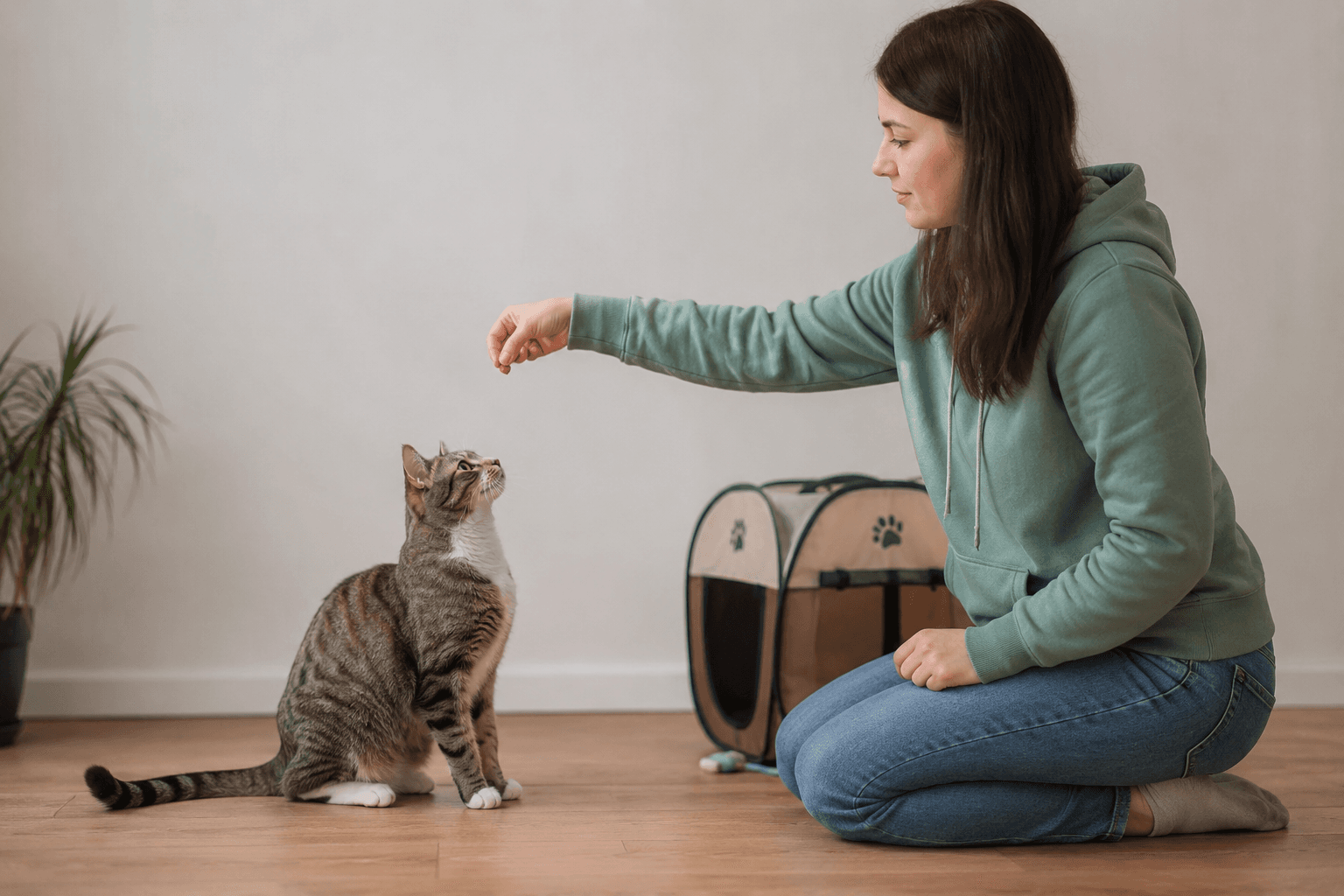
The First Week at Home — How to Start Your Life Together on the Right Paw 🏠
The first week is the most important week in your kitten's life with you. What happens during it shapes her personality, her trust in you, and how she interacts with your entire home — for years to come.
Don't put too much pressure on yourself. Just understand what's going on in that little head of hers, and you'll find everything flows naturally 😊
🏠 Before the Kitten Arrives — Is Your Home Ready?
Preparing for your kitten before she arrives isn't a luxury — it's an investment in both your peace of mind and hers.
What you'll need before the big day:
- 🛏️ A soft bed or warm cushion in a quiet corner, away from noise
- 🚽 A clean litter box — preferably unscented at the start
- 🥣 Two separate bowls for food and water, placed away from the litter box
- 🧸 One or two toys only — don't overwhelm a young kitten with too many at once
- 🧳 A carrier — leave it open in her room as an optional "cozy den" from day one
Common mistakes to avoid before she arrives:
- ❌ Don't suddenly switch her food — ask the breeder what she's been eating and stick with it. Any abrupt change can cause uncomfortable digestive upset
- ❌ Don't place the litter box next to a noisy washing machine or in a busy area
- ❌ Don't let her roam the entire house on day one — start with one quiet room and gradually open things up
😰 Your Kitten Is Scared — and That's Completely Normal. How Do You Break the Ice?
Did you picture bringing your kitten home and playing together from the very first minute? 😄 The truth is, most young kittens spend the first 24–48 hours hiding under the bed or tucked away in a corner.
This doesn't mean she doesn't like you — it means her nervous system is processing an entirely new world: different smells, different sounds, and people she's never met before.
How to help her settle in faster:
- 🤫 Quiet is your first gift to her: Reduce loud noises and sudden visits for the first couple of days
- 👃 Let her sniff you first: Sit calmly on the floor and let her come to you — don't reach out and grab her
- 🧣 The scent trick: Place a piece of your worn clothing near her resting spot — your familiar scent helps her feel safe
- ⏳ Give her time: Some kittens settle in a day, others need a full week — patience here isn't optional, it's the only way
🚨 Important: If 72 hours pass and your kitten still hasn't eaten, drunk any water, or used the litter box — this goes beyond normal shyness and warrants a vet's opinion promptly.
🛏️ Her Own Space — Why She Needs "Her Corner" More Than You Might Think
Cats are naturally territorial animals — meaning they need a place that feels entirely theirs, somewhere to retreat when they feel stressed or overwhelmed.
Imagine being in a stranger's home with no spot that feels safe or familiar — that's exactly how your kitten feels without her own corner.
How to create her perfect sanctuary:
- Choose a quiet spot, away from constant foot traffic
- Place her soft bed there, with a piece of your clothing nearby
- Never force her out of it when she's scared — let her emerge on her own terms
- Don't put the litter box close to her sleeping area — cats instinctively avoid resting near their bathroom 🚽
🚽 Litter Box Training From Day One — The Secret That Saves You So Much Trouble
Here's the reassuring news: cats are naturally inclined to use a litter box — their instinct drives them to bury their waste. Your job isn't to teach her from scratch; your job is to make it easy for her to find the box and feel comfortable using it.
The Golden Rules of the Litter Box:
| Rule | Why It Matters |
|---|---|
| One box per cat, plus one extra | Avoids "queuing" and tension between cats |
| Clean it daily, at minimum | A dirty box gets rejected — and she'll find an alternative, usually your rug 😅 |
| Keep it in a consistent, quiet spot | Suddenly moving it confuses her |
| Avoid heavily scented litter at first | Strong fragrances can put off sensitive kittens |
| Keep the sides low to begin with | A young kitten needs to climb in easily |
First steps for litter training:
- 🐱 Right after she eats, gently place her in the litter box — this is when she'll naturally need to go
- 👋 Let her sniff and explore it freely — don't grab her paws and dig for her
- ✅ If she uses it — praise her immediately in a soft, warm voice and offer a small treat
- ❌ If she goes elsewhere — never punish her. Simply clean the spot thoroughly with an enzymatic cleaner to eliminate the scent, so she isn't drawn back to the same place
💡 Golden tip: If your kitten suddenly stops using the litter box after being perfectly consistent — this is usually a medical signal, not a training problem. A urinary tract infection, for example (imagine the burning sensation she'd feel), can make her associate the box with pain and start avoiding it.
🩺 Get peace of mind before the worry grows:
If you notice anything unusual in your kitten's first few days — not eating, not drinking, trembling, or blood in the litter box — don't wait.
Scotty app is here for you anytime 📱 Film or record a short video of your kitten's condition, browse the profiles of specialist vets, and book your appointment at the exact time and date that works for you — straight from the in-app calendar.
Plans start from SAR 69 only — including a 30-minute call with the vet, a certified digital prescription you can fill online, a complete health file for your pet, and chat follow-up for a full week, plus a free follow-up call to make sure your little one is doing well 💛
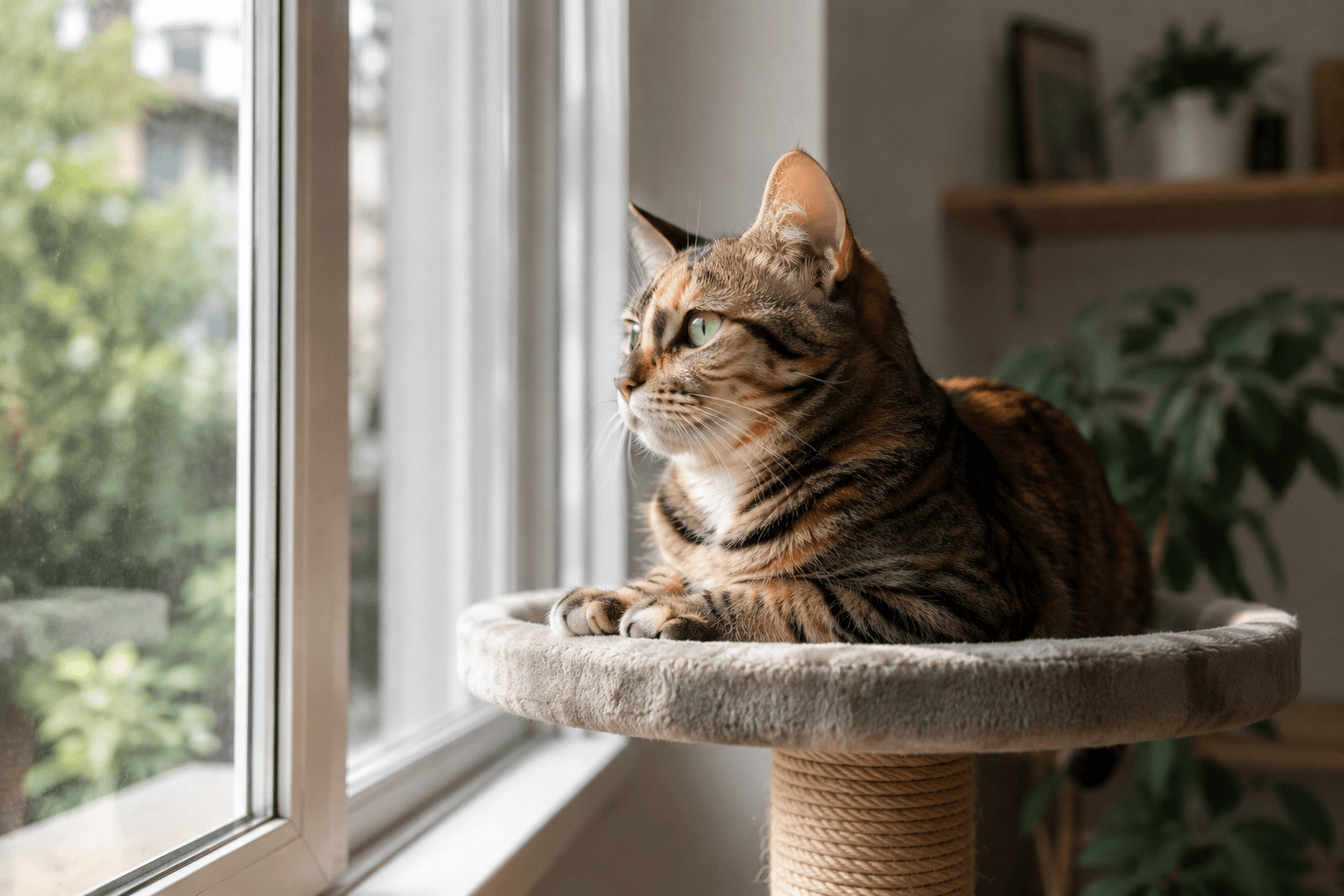
Understanding Cat Language — Know How She Thinks So You Can Actually Train Her 🧠
Cats aren't stubborn and they're not "untrainable" — they simply think in a completely different way from dogs, or even from what we humans expect 😄
Once you understand how that little mind of hers works, you'll discover that training becomes easier and a lot more enjoyable — and you'll stop feeling like you're fighting a losing battle 💨
🗣️ Cats Don't Learn Through Yelling — Understanding How She Thinks Changes Everything
Let's be straightforward: cats don't understand punishment the way we imagine.
If you shout at her for scratching the sofa — she won't understand "scratching the sofa is wrong." She'll only understand that you've become a source of stress and fear in that moment, and that quietly damages your relationship with her over time.
How does a cat actually think?
- 🧩 Cats live entirely in the present moment — your reaction needs to be immediate (within two seconds), otherwise she won't connect the behaviour to the consequence
- 🔗 She learns through association — this behaviour = a pleasant outcome, or this behaviour = a neutral/unpleasant outcome
- 👑 Cats don't recognise the concept of authority the way dogs do — to her, you are "a trusted source of safety, food, and fun," not a pack leader she blindly obeys
The practical takeaway: Instead of punishment, focus on making the right behaviour enjoyable and rewarding, and the unwanted behaviour boring and pointless.
🎯 Positive Reinforcement — The Most Powerful Tool You Have
Positive reinforcement simply means: reward her immediately when she does something right.
This isn't just a feel-good theory — it's the most scientifically proven and effective method for training cats, and it builds a bond of trust between you that won't break.
Types of rewards that work well with cats:
| Reward Type | Practical Example | Best Used When? |
|---|---|---|
| 🍗 Food reward | A small piece of boiled chicken or a cat treat | Ideal for teaching something new |
| 🎮 Play reward | Waving a feather wand or dangling a string | For cats who value play over food |
| 🤲 Touch reward | A gentle stroke behind the ears or under the chin | Once you know her favourite spots |
| 🗣️ Verbal reward | A warm, soft "good girl" | Should always accompany any other reward |
The golden rules of positive reinforcement:
- ⚡ Timing is everything: The reward must come within one to two seconds of the behaviour — even a short delay breaks the association in her mind
- 🎯 Be specific: Reward a clear and defined behaviour, not randomly
- 📉 Gradually fade food rewards: Once she's learned the behaviour, slowly replace food treats with praise and gentle touch
⏰ Timing Is Everything — When to Train and When to Stop
One of the most common mistakes owners make: attempting training at completely the wrong time.
Best times to train:
- 🌅 Shortly before a meal — she's slightly hungry and far more motivated by food rewards
- 🎉 Right after waking up — her energy is high and her mind is fresh
- 🐾 During her natural activity window — most cats are most active in the early morning and late afternoon
Times to never attempt training:
- ❌ Immediately after eating — she wants to sleep, not learn
- ❌ When she's scared or stressed — information simply doesn't sink in when she's in a fearful state
- ❌ When you're frustrated or in a bad mood — cats are incredibly sensitive to your emotions and pick up on them instantly
How long should each session be?
This is a point many owners overlook 👇
| Kitten's Age | Ideal Session Length | Sessions Per Day |
|---|---|---|
| 2–4 months | 2–3 minutes only | 3–4 times |
| 4–6 months | 5 minutes | 2–3 times |
| 6 months and older | 10–15 minutes | 1–2 times |
Young kittens experience mental fatigue very quickly — a short, focused, enjoyable session is a thousand times better than a long one that ends in frustration for both of you 😅
😼 Cat Body Language — Signs That Tell You Whether Training Is Going Well
Your cat is communicating with you all the time — just not with words! 🐱
Learning to read her body language lets you know when she's relaxed and ready to learn, and when she's stressed and needs a break.
Signs of comfort and readiness to learn ✅
- 🐾 Tail held high and straight — a sign of confidence and ease
- 👀 Half-closed eyes or a slow blink — one of the highest expressions of trust and affection in cats
- 😺 Ears facing forward or relaxed to the sides
- 🔄 Rolling onto her back and exposing her belly — very high trust (though not always an invitation for a tummy rub!)
Signs of stress and a need to stop 🛑
- 👂 Ears flattened back against the head — tension or fear
- 🐍 Tail swishing rapidly from side to side — unlike dogs, in cats this signals agitation and irritation, not excitement
- 👁️ Hard, direct stare with dilated pupils — high alert
- 💨 Slight panting or repeated lip-licking — emotional stress
💡 The golden rule: The moment you spot any stress signal — stop the session immediately and calmly, and give her space. Ending on a positive note before she tires is always better than pushing on until things fall apart.
Quick Reference — Read Your Cat's Body Language in Seconds:
| Signal | Meaning | What to Do |
|---|---|---|
| Tail held high | Happy and relaxed | Continue training |
| Tail swishing rapidly | Irritated or agitated | Pause and give her space |
| Ears flattened back | Scared or tense | Stop — don't approach |
| Slow blink | Trusts and loves you | Slow blink right back 😊 |
| Belly exposed | High level of trust | A great moment for gentle stroking |
| Repeated lip-licking | Anxious or under stress | Change the environment or end the session |
🩺 One important moment for the worried owner:
Sometimes what looks like a "training problem" is actually hidden pain — a cat who suddenly bites when you touch a certain area, or one who was affectionate and has become aggressive for no clear reason. These are symptoms worth a vet's eye.
With Scotty app, you can film the unusual behaviour and attach it as a video before your session so the vet can see it for themselves 🎥 Book your appointment from the calendar at a time that suits you — plans from SAR 69, a 30-minute call with a specialist vet, and a certified digital prescription if needed. And most importantly: chat follow-up for a full week + a free follow-up call — because your peace of mind is worth it 💛
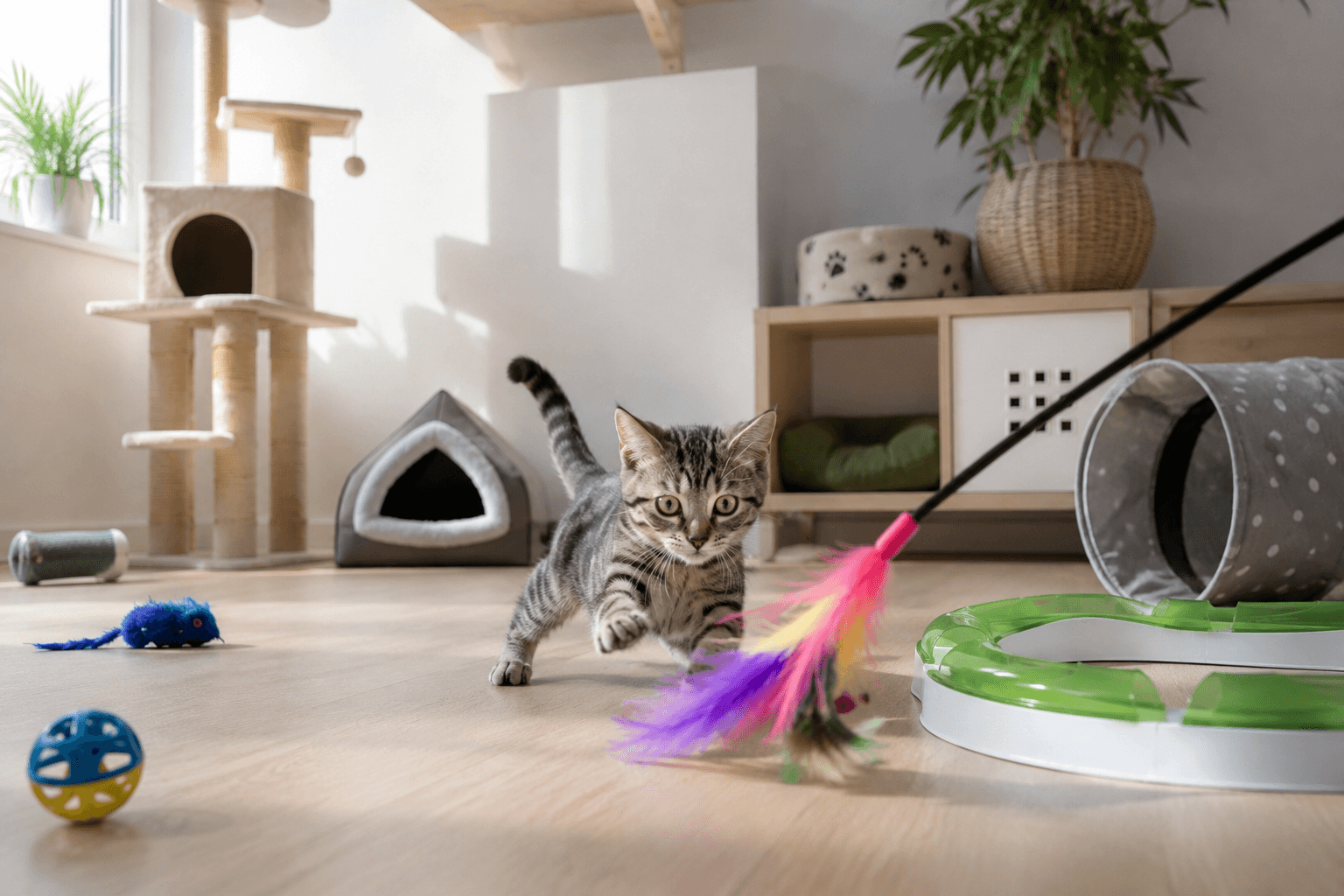
The Essential Skills Every Kitten Should Learn 🎓
This is the section most owners wish they'd found from the very beginning! 😄
These skills aren't "nice to haves" — they are fundamentals that keep your cat safe, make your life easier, and strengthen your bond for years to come.
Every skill taught while she's young = hours and hours of future stress saved 🙌
✋ The Loving "No" — How to Stop Unwanted Behaviour Without Breaking Her Trust
The first question every new owner asks: "How do I tell her no?"
The answer isn't in shouting and it isn't in a tap on the nose — the answer lies in understanding one simple principle: A cat repeats behaviour that gets her something, and drops behaviour that gets her nothing.
The "Active Ignore" Technique — Your Most Powerful Tool:
When she does something you don't want — don't shout, don't punish. Simply stop all interaction immediately.
- Get up calmly and walk away
- No eye contact, no words, no reaction whatsoever
- Literally: zero attention
The clever cat (and they're all clever 😄) quickly learns that this behaviour = "gets me nothing enjoyable."
Practical Examples:
| Unwanted Behaviour | The Right Response |
|---|---|
| Biting during play | Stop the game immediately, get up, ignore her for two minutes |
| Waking you up in the early hours with meowing | Don't get up and don't respond — any response at all reinforces the behaviour |
| Jumping on the counter | Remove her calmly without a word and offer her an alternative |
| Scratching the sofa | Guide her to the scratching post and reward her there |
⚠️ Important warning: Spraying water, tapping the nose, shouting — these methods create a cat who fears you, not a cat who has learned. The difference is enormous over the long run.
💅 Nail Trimming and Ear Cleaning — Train Her Young and Save Yourself the Trouble
This is the point owners tend to overlook — and then pay the price for later! 😅
A cat who never got used to being handled when she was young = a cat who turns into a "tiny lion" the moment you try to trim her nails as an adult.
Steps for Handling Training:
Phase One — Getting Comfortable with Touch:
- 🤲 Hold her paw gently for two seconds, release it, and immediately offer a reward
- 👂 Play gently with her ears, then reward
- 👄 Open her mouth for one second, then reward
- Repeat this daily for a week before attempting any actual grooming
Phase Two — Nail Trimming:
- Sit comfortably with her in your lap or on a stable surface
- 🐾 Gently press the paw pad to extend the nail
- Clip only the clear tip of the nail — stay well away from the pink part (known as the "quick" — it contains blood vessels, and cutting it is painful and causes bleeding)
- One or two nails per day is perfectly fine at the start — you don't have to do them all in one go
Phase Three — Ear Cleaning:
- Use a cotton pad or soft cloth with a cat-specific ear cleaning solution
- 👂 Clean the outer part only — never insert anything deep into the ear canal
- Normal discharge colour: light brown to faint yellow
- 🚨 Very dark colour, unpleasant smell, or a large amount of discharge = a sign of infection or ear mites that needs a vet
🧳 Carrier Training — Because the Vet Visit Is Coming Whether You Like It or Not
Most cats hate the carrier for one simple reason: Its appearance = a stressful trip to the clinic — so they've come to associate it with dread.
The solution? Make the carrier a normal part of her everyday life from day one.
A Two-Week Carrier Training Plan:
- Days 1–3: Place the carrier open in her room with a piece of your clothing inside — let her explore it entirely on her own terms
- Days 4–6: Place treats or her favourite toy inside — she goes in, takes them, comes back out. No big deal
- Days 7–10: When she walks in on her own, gently close the door for 30 seconds, then open it and give her a reward
- Days 11–14: Gradually increase the time inside, and carry her around the house in the carrier for a short while
The result? A cat who walks into the carrier by herself because it's "a familiar and comfortable space" — not a battle every single time you need to take her to the vet 🎉
🔔 Name Recognition Training — Simple, But It Could Save Her Life One Day
Teaching your cat to respond to her name is a skill that could literally save her life — if she ever slips outside or hides somewhere dangerous.
How to Train It (3 minutes a day is all you need):
- 🎯 Wait for a calm moment when she's nearby
- 🗣️ Call her name once in a soft, warm tone — just once, no repeating
- ✅ If she looks at you or moves toward you — immediate reward and enthusiastic praise
- 🔄 Repeat 5–10 times per session
- 📈 Gradually call her from different rooms and increase the distance
Common Mistakes in This Training:
- ❌ Repeating her name too often without a reward — she starts tuning it out
- ❌ Calling her name when you want to tell her off — she'll associate her name with something negative
- ❌ Using different tones each time — stick to one consistent warm tone at the beginning
🛋️ Protecting Your Furniture — Teach Her Where to Scratch Instead of Punishing the Scratching
The honest truth every owner needs to hear: Your cat will never stop scratching — it's an instinctive behaviour that cannot be switched off. 🐾
Scratching is a biological necessity for her — she's trimming her nails, stretching her muscles, and leaving visual and scent markers that make her feel secure in her territory.
Your role isn't to stop the scratching — your role is to direct it to the right place.
How to Choose the Right Scratching Post:
| Type of Scratcher | Advantages | Best For |
|---|---|---|
| 🌴 Tall vertical post | Allows a full body stretch | Most cats |
| 📐 Flat horizontal pad | Some cats strongly prefer it | Cats who scratch carpets |
| 🐱 Sofa-side scratcher | Hangs directly on the sofa | Redirecting attention away from furniture |
| 🌿 Jute or sisal material | A texture most cats love | The best first option to try |
The Furniture Redirection Plan:
- 📍 Place the scratching post right next to the sofa or the exact spot she's been scratching — not in a faraway corner
- 🎉 The moment she uses it — immediate reward and warm praise
- 🍋 Temporarily place double-sided tape on the furniture area she's been targeting — cats dislike the sticky texture
- 📏 Make sure the post is stable and doesn't wobble — if it moves while she's scratching, she'll get startled and avoid it
🩺 If you notice something concerning during training:
Sometimes an owner picks up on things like: a slight limp after play, persistent licking of a specific spot, or avoiding putting weight on one paw — these aren't training issues, these are medical signals.
With Scotty app you can attach photos or a video of the problem before your session so the vet can see everything with their own eyes 👁️ Choose your vet from their full profiles, book at a time that suits you, and receive a certified digital prescription you can fill online without any hassle. All of this with a full week of chat follow-up and a free follow-up call — starting from SAR 69 only 💛
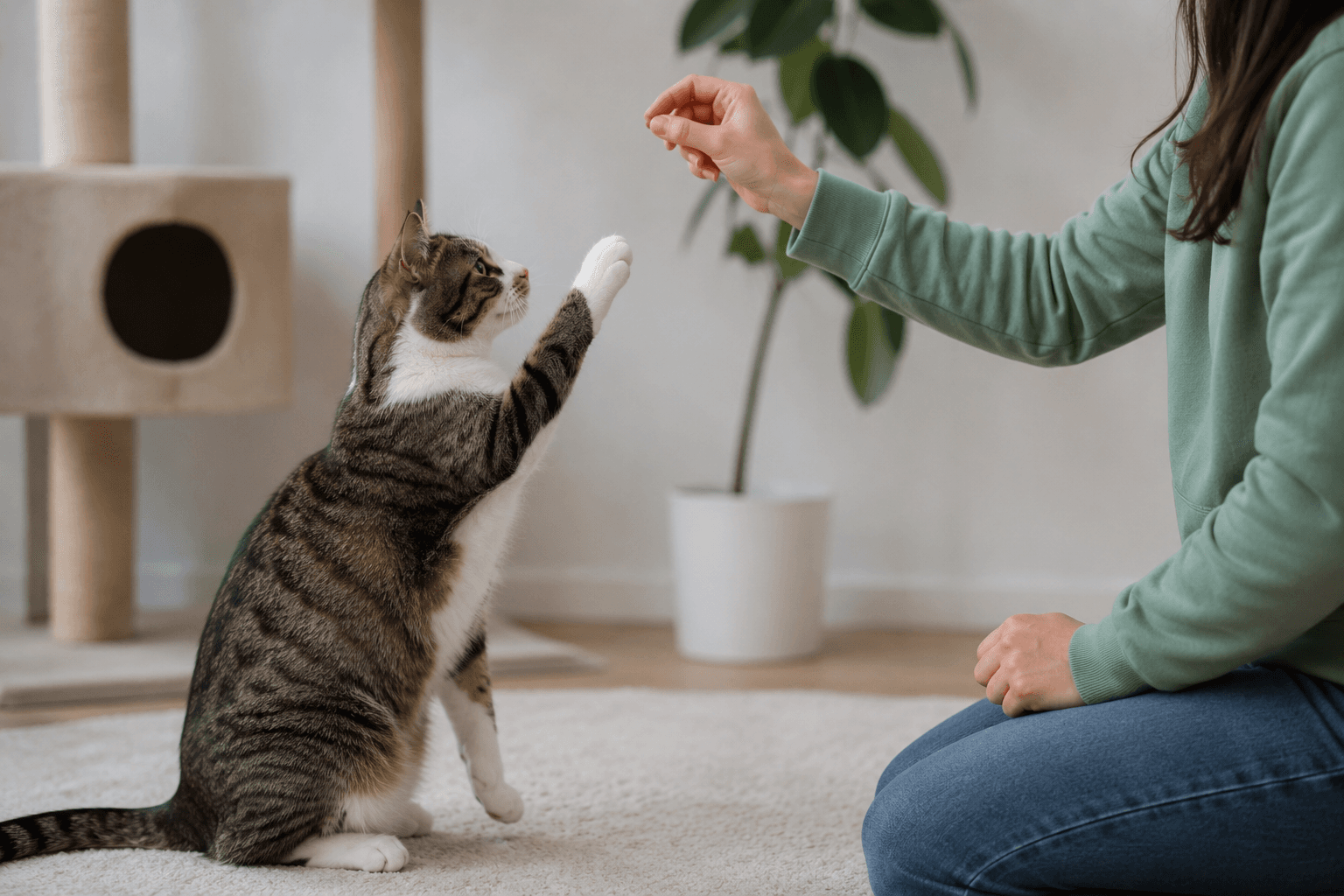
Common Challenges and Practical Solutions From Day One 🛠️
We've reached the final section — and honestly, this is the one most owners wish they'd found before going through the experience themselves! 😅
Every challenge in this section is something we've heard time and again from cat owners — and every solution here is tried, tested, and genuinely effective.
Let's see which one sounds familiar! 🐾
😿 My Kitten Bites and Scratches During Play — Is This Aggression?
The question we receive most from new owners — and the answer puts a lot of people at ease:
In most cases, no — this isn't aggression. This is unregulated play. 🎮
Kittens learn the boundaries of play from their siblings and mother during the first weeks of life. A kitten who was weaned too early or raised alone never learned those boundaries— so she plays with the same intensity she would have used with her littermates.
The Practical Solution, Step by Step:
- 🛑 The moment she bites: Make a soft, sharp sound — "ouch!" — not a shout, just a sound that surprises her
- ✋ Stop the game immediately and slowly withdraw your hand without any sudden movement that might excite her further
- 🚶 Get up and walk away — complete ignore for two minutes
- 🎯 Always play with a toy, never with your bare hand — your hand is not a toy!
| ❌ Common Mistake | ✅ The Right Alternative |
|---|---|
| Wiggling your fingers in front of her as a toy | Use a wand toy or a dangling string |
| Laughing when the bite is light | Immediate ignore — any reaction at all reinforces the behaviour |
| Overreacting dramatically | A single soft surprise sound, nothing more |
| Continuing to play after she bites | Stop the game instantly, without exception |
🚨 When does biting become a real concern? If your kitten bites with excessive force accompanied by hissing and puffing up, attacks without any obvious trigger, or suddenly shifts from being affectionate to aggressive — this warrants a medical assessment before any further training attempts.
🌙 She Wakes Me Up at Night — Why Does This Happen and How Do I Handle It Kindly?
"My cat drives me absolutely mad all night and I just want to sleep!" 😩 We've heard this one countless times — and there's actually some reassuring news mixed in with the part that requires patience!
The reassuring part: This is completely normal biologically. Cats are crepuscular animals— meaning their natural rhythm makes them most active at dawn and dusk specifically, not midday and not the middle of the night.
Young kittens in particular carry enormous stored energy — and if it isn't spent during the day, it gets spent at night, at your expense! 😄
The Real Fix — Tire Her Out the Right Way Before Bed:
- 🎮 An intense play session of 20–30 minutes before your bedtime — mimic the hunt: move the toy fast, then slow, then stop, and repeat
- 🍗 Serve her largest meal immediately after play — in the wild, the pattern is hunt, eat, groom, sleep. Follow that natural sequence
- 🌙 Don't respond at night — any response from you, even telling her off, teaches her that nighttime disruption "works"
- 🚪 Closing the bedroom door is a completely valid option if you need it in the early weeks
The Ideal Pre-Bedtime Routine:
| Time Before Bed | Activity |
|---|---|
| 45 minutes before | Active, energetic play session |
| 20 minutes before | Serve her meal |
| 10 minutes before | Calm time, gentle stroking |
| Bedtime | Lights off, complete quiet |
🙈 She's Very Shy and Scared of Strangers — When Is It Normal and When Should You Worry?
Some cats are naturally shy — and that's a beautiful part of their personality 🐱 But there's a real difference between normal shyness and fearfulness that genuinely affects her quality of life.
Normal Shyness — What It Looks Like:
- 🐾 She hides when guests arrive and reappears once they've gone
- 👀 She watches from a distance and approaches when she feels safe
- 😺 Around her own family in her usual environment, she's completely relaxed and herself
Concerning Fear — What It Looks Like:
- 😰 Scared even of the people she lives with every day
- 🚫 Won't eat or drink if anyone else is in the room
- 🫨 Trembling or involuntary urination when stressed
- 🙉 Hiding continuously for very long stretches even in a calm, quiet home
If Your Cat Is Shy — How to Help Her Open Up:
- 🤝 Ask guests to completely ignore her at first — cats are oddly drawn to the people who show no interest in them (strange but absolutely true! 😄)
- 🍗 Have guests toss treats in her direction from a distance, without making direct eye contact
- ⏳ Never force interaction — trust is built over time, not through pressure
- 📅 Gradual and repeated exposure to new situations is the most effective approach
🐾 Your Kitten Refuses Food or Eats Ravenously — Signs You Shouldn't Ignore
Refusing Food:
A young kitten who hasn't eaten for more than 12–24 hours is a situation that deserves attention.
Possible causes range from mild to serious:
- 😤 A sudden change in food type — her stomach hasn't adjusted yet
- 🌡️ A slight temperature — cats lose their appetite when they're feeling under the weather
- 😰 Emotional stress — new guests, changes in the home, a loud or frightening noise
- 🦷 Mouth or dental pain — watch whether she chews on one side only
- 🤒 An underlying illness that needs a proper medical assessment
Eating Ravenously:
The opposite extreme — and one that worries many owners too — also has causes you might not expect:
- 🪱 Worms and parasites — they steal nutrition from her body, leaving her feeling constantly hungry despite eating
- 🩺 Hyperthyroidism (overactive thyroid gland) — particularly in older cats, they eat more yet lose weight
- 😟 Anxiety and boredom — yes, some cats are emotional eaters, just like us!
- 📏 Unrestricted access to food — if food is available around the clock, many cats will eat well beyond what they actually need
🆘 When Is Strange Behaviour a Medical Signal and Not a Training Issue?
This is the single most important question in the entire article — and the answer could save your cat's life.
The Golden Rule: Any sudden change in behaviour in a cat who was previously normal = a medical cause until proven otherwise.
Signs That Need a Vet Immediately 🚨
- 🚽 A sudden change in litter box habits after being perfectly consistent
- 💧 Drinking far more water than usual — if you notice her sitting by the bowl for long stretches
- ⚖️ Noticeable weight loss despite normal or increased eating
- 🤸 A change in the way she walks, climbs, or jumps
- 😾 Sudden aggression from a cat who was previously affectionate
- 🙁 Continuous hiding combined with refusing to eat
- 😮💨 Breathing with an open mouth or panting — this is never normal in cats
- 🤮 Vomiting or diarrhoea lasting more than 24 hours
Signs That Need Monitoring Within 48 Hours ⚠️
- A mild, unexplained change in appetite
- Repeated sneezing or eye discharge
- Licking one particular spot repeatedly and excessively
- A subtle shift in her usual daily activity level
🩺 Scoty is right there with you in every one of these moments:
The moment you feel "something isn't right with my cat" — don't wait for a clinic appointment, don't worry alone, and don't fall down a Google rabbit hole that leaves you more anxious than before 😅
Scoty app is your veterinary clinic in your pocket, available around the clock 📱
Here's how it works:
- 📋 Browse vet profiles and choose the specialist who feels right for you
- 📅 Book your appointment at the exact date and time that works for you, directly from the calendar
- 🎥 Attach photos or a video of your kitten's condition before the session — the vet sees everything before your call even begins
- 📞 A 30-minute call with the vet to discuss the case in full detail
- 💊 A certified digital prescription you can download and fill online with ease
- 📁 A full case report saved in your pet's health file — a complete medical history, all in one place
- 💬 Chat follow-up for a full week, around the clock — any question that crosses your mind, the vet is there
- 📞 A free follow-up call to confirm your little one is doing well
Plans starting from SAR 69 only — because your peace of mind and your pet's health are beyond price 💛
A Final Word — Your Little Cat Is Lucky to Have You 🐱💛
You made it to the end of this guide — and that alone says something wonderful about the kind of owner you are.
Raising a kitten isn't a perfect, mistake-free journey. There are moments that make you laugh, moments that exhaust you, and moments where you look at her and think "why would you do that?!" 😂
But every moment of patience, every small reward, and every consistent boundary you hold — builds something truly priceless: A real, lasting trust between you and your cat that will carry through every year of her life with you. 🐾
The Key Takeaways From Our Journey Together:
- 🏠 The first week is the most important — preparation and patience are the keys
- 🧠 Understanding how cats think turns training into a pleasure, not a battle
- 🎓 Core skills taught young save years of frustration down the road
- 🛠️ Most challenges have practical solutions — and some are medical signals that deserve a vet
And always remember: you don't have to figure everything out alone — Scotty is here whenever you need a trusted vet's opinion, any time of day, from the comfort of your home. 💙
Found this guide helpful? Share it with everyone who loves their cat as much as you do 🐾✨