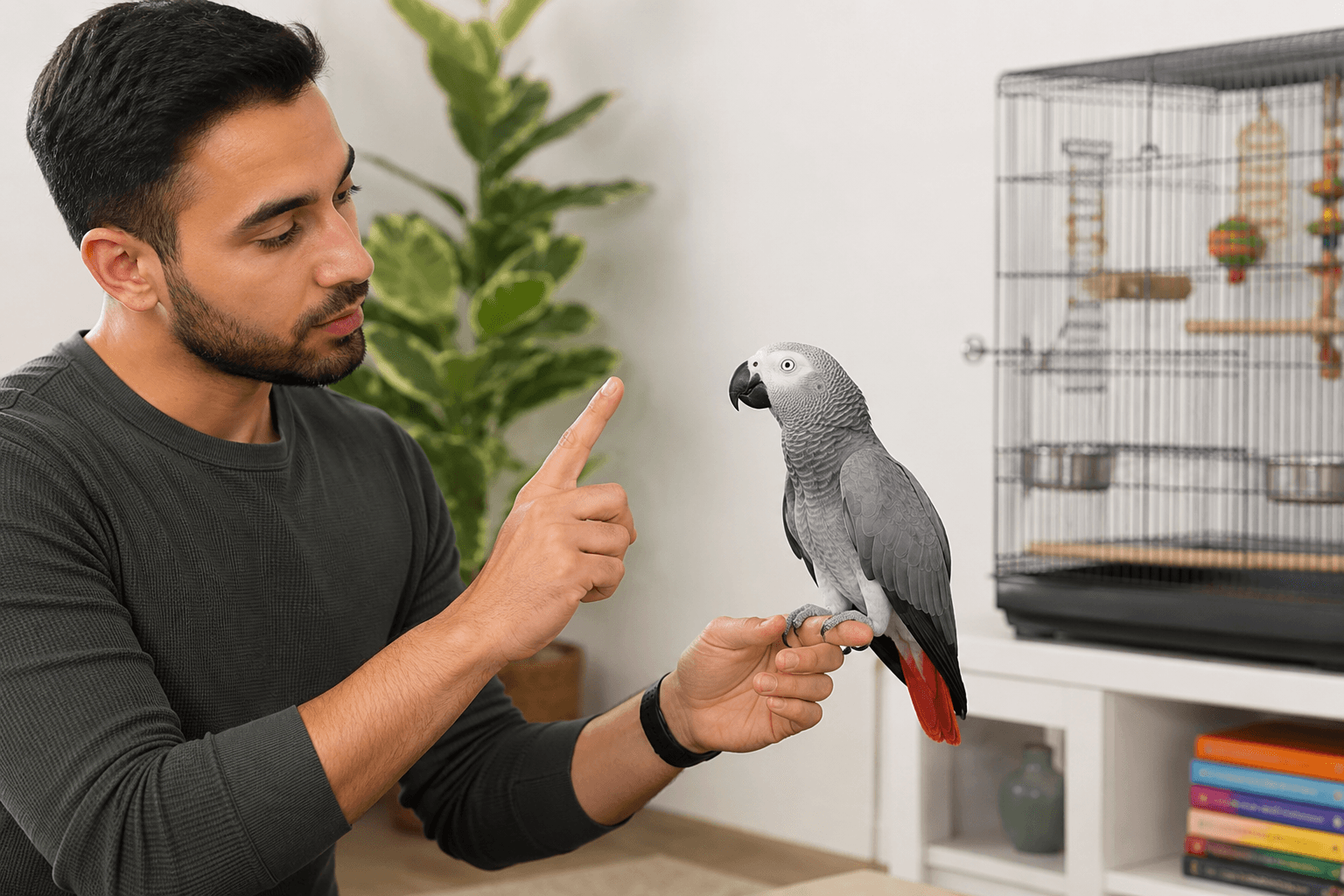
Understanding Your Bird's Nature — The Zero Step Before Any Training
Before you think about taming birds or reaching toward your bird's cage, there's one question you need to answer first:
Do you truly understand how your bird thinks?
Most bird owners skip this step entirely and rush straight into training, only to find themselves facing a frightened, stressed bird that refuses to cooperate. Understanding your bird is the foundation on which everything else is built.
Why Is Your Bird Afraid of You at First?
Imagine a giant creature suddenly invading your space and reaching out its enormous hand toward you — a creature you don't know and whose intentions you can't read.
That's exactly what your bird experiences when you approach them for the first time. 😟
Birds in nature are prey animals, not predators. Their entire biological evolution is built on one principle: suspecting anything new = staying alive.
Even birds that were born and raised at home still carry this instinct in their DNA. So their fear of your large hand or sudden movements isn't "aggression" or "stubbornness" — it's a completely natural, hardwired survival response.
What this means practically:
- 🐦 Don't get angry if your bird flaps, screams, or nips — this is their natural defense.
- 🐦 Don't see their fear as a failure on your part or theirs — it's simply the starting point.
- 🐦 Time and patience aren't luxuries here — they're the foundational pillars of any successful taming journey.
Bird Body Language — Learn to Read the Signs Before You Touch
Your bird is communicating constantly, just not with sounds you can hear — but with movements you can see. 👀
Learning to read their body language is the most important skill you'll develop as an owner, because it tells you when your bird is ready to interact and when they need space.
Signs of Comfort and Relaxation:
- Feathers slightly puffed with a relaxed body posture ← means they're comfortable and warm 😌
- Scratching their head with a foot or preening their feathers ← a clear sign of ease and contentment
- Standing on one foot ← light dozing or deep relaxation
- Slow blinking — eyes opening and closing slowly ← they're saying: "I'm okay, I trust you"
Signs of Stress and Fear:
- Feathers pressed tightly against the entire body ← preparing to flee 🚨
- Rapid swaying from side to side ← severe tension and discomfort
- Staring with one eye fixed on you (side-eye stare) ← threat assessment mode
- Spreading wings to appear larger ← a warning: "Don't come any closer"
- Biting and nipping at any touch ← not yet ready for direct handling
The Golden Rule: Never begin a training session if your bird's body language is saying "no." Forcing interaction will set their trust back by weeks.
The Difference Between Home-Raised and Wild-Caught Birds
Not all birds start from the same point, and knowing this will save you from setting unrealistic expectations for yourself. 📊
Hand-Fed Birds:
These are birds that were fed by human hands from the moment they were hatchlings. They associate people with food, warmth, and safety, which means:
- They start with a significantly higher baseline of trust.
- They need far less time before accepting direct handling.
- They often love being held and cuddled from the very first days.
Common examples: hand-fed African Grey parrots, cockatiels, and hand-raised canaries.
Cage-Born Birds With No Human Socialization:
These birds grew up watching humans from a distance, with no direct physical interaction:
- They need more time to build familiarity.
- Keep sessions very short in the beginning — just 5 minutes is enough.
- Their progress is wonderful but slower — and that's perfectly normal.
Wild-Caught or Semi-Wild Birds:
The most challenging category, as they never knew humans as safe companions to begin with:
- They may need weeks or even months before any attempt at direct handling.
- Some may never reach the point of being fully held, and that's okay.
- The priority is providing them with a safe, calm environment rather than pressuring them.
💡 Pro Tip: Always ask the seller about the bird's background before purchasing. That single piece of information can save you weeks of confusion.
The Ideal Age to Start Taming Birds
"Is it too late to tame my bird?" — this is one of the most common questions we hear. 🤔
The short answer: No, it's never too late. But there are important differences to understand:
Young Birds (Under 6 Months):
This is the golden window for taming. A young bird's brain is actively building its social maps, and every positive experience now becomes hardwired as fact: "Humans are safe."
- They respond to training incredibly quickly.
- Trust builds at record speed.
- Learning is dramatically easier than with adults.
Adult Birds (Over One Year):
Don't give up! Adult birds are fully capable of adapting and learning, but:
- They need more time and patience.
- Break old habits with gradual environmental changes.
- Shorter, more frequent sessions produce better results than long, infrequent ones.
Senior or Traumatized Birds:
This can be the most challenging scenario, especially if the bird has previously experienced force or punishment. In these cases, you may benefit from professional guidance to create a customized taming plan that fits their specific situation.
If you notice unexplained behaviors or zero progress despite your consistent efforts, booking a consultation with a vet who specializes in bird behavior through SCOTY could save you months of guesswork and put your journey on the right track from the very first session. 🌟
Section One Summary:
Before any training begins, sit and observe your bird. Understand where they came from, how old they are, and what their body language is telling you right now. The more you know your bird, the faster and deeper and more beautiful your taming journey will be.
In the next section, you'll learn the complete practical roadmap — from "a bird that won't let you near them" to "a bird that flies to you with love." 🐦💛
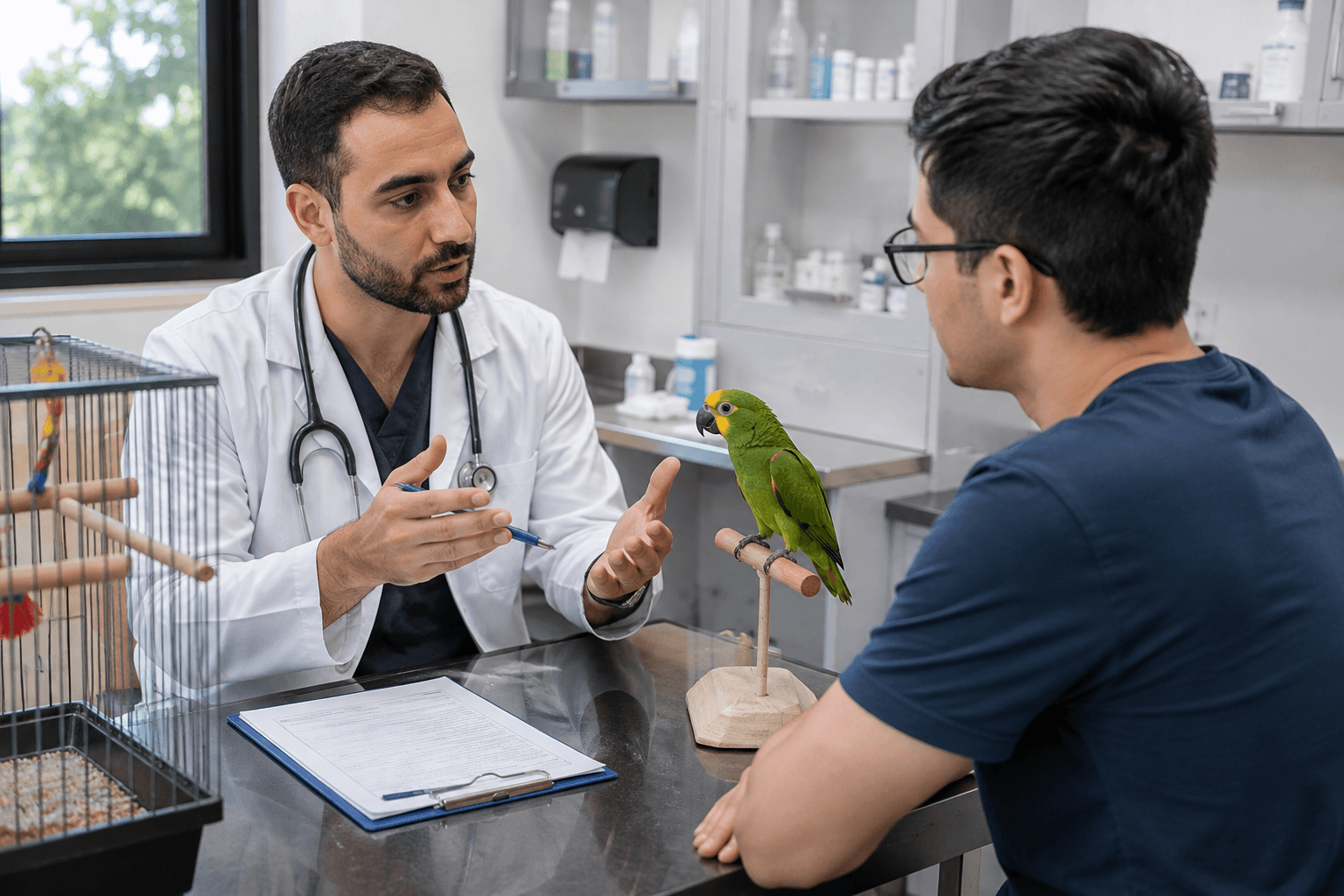
Taming Birds Step by Step — From Fear to Trust
Now that you understand how your bird thinks and why they behave the way they do, it's time for the practical part every owner has been waiting for. 🎯
But before we begin, one golden rule to keep close to heart:
Taming isn't a one-time event — it's a relationship built day by day.
Don't measure your success by one or two weeks. Measure it by the quality of trust that accumulates between you and your feathered companion. Now, let's get started! 🚀
Stage One — Building Familiarity Through Voice and Presence
In this stage, your hand does not enter the cage. You are simply teaching your bird that your presence = safety. 🕊️
How to Apply This Stage:
- Sit beside the cage daily for 10 to 15 minutes without staring directly at your bird — direct eye contact is interpreted as a threat in the bird world.
- Speak in a calm, low voice. The topic doesn't matter — you can tell them about your day, read a book aloud, or hum softly. 🎵
- Avoid sudden movements or loud noises during this time specifically.
- Repeat this routine at the same time every day — birds love predictable routines because consistency makes them feel safe.
When to Move to the Next Stage:
When your bird begins to:
- Move closer to your side of the cage on their own.
- Stop flapping and screaming when you approach.
- Show "slow blinking" — closing their eyes slowly in your presence.
⏱️ This stage can take anywhere from 3 days to 3 weeks depending on your bird's history and personality. Don't rush it.
Stage Two — Stick Training
Before getting your bird used to your hand directly, a stick serves as the safe bridge between you both. 🪵
Why Start With a Stick?
Because your hand is large, warm, and moves in unpredictable ways — all of which are terrifying for a fearful bird. A stick, by contrast, is neutral. It doesn't pulse, doesn't move on its own, and carries no scent. Far easier to accept.
Stick Training Steps:
Step 1: Choose a wooden or plastic dowel that's the right diameter for your bird's feet — not too thin, not too thick.
Step 2: Place the stick inside the cage without attempting to touch the bird — simply leave it there for a few minutes so they can get used to its presence.
Step 3: After two or three days, slowly move the stick toward the bird's chest from below — specifically at foot level, just beneath the belly.
Step 4: When the bird feels the stick against their chest, natural instinct will prompt them to lift one foot and step up. The moment they step up, say calmly: "Good bird!" and immediately offer a small treat. 🎉
Step 5: Repeat this exercise 3 to 5 times per session — no more, to avoid boredom or fatigue.
💡 Important Note: The treat you choose should be something your bird absolutely loves — sunflower seeds for some species, or a small piece of fresh fruit. This is their "payment" for cooperating, so respect its value. 🍓
Stage Three — Stepping Up on Your Finger and Direct Handling
This is the most exciting stage — the moment your bird transforms from a "guest in a cage" to a true companion. 🤝
But it's also the stage where most owners make the costly mistake of rushing.
When to Transition From Stick to Finger?
Only when your bird steps onto the stick quickly and calmly with no hesitation or tension, and when they appear relaxed on the stick for at least one continuous minute.
How to Make the Transition:
- Begin gradually by shortening the distance between your hand and the bird on the stick — meaning, hold the stick closer to your bird over time.
- After a few days, hold the stick at the midpoint while the bird is on it, then start extending your finger beside the stick.
- Once they're used to seeing your finger as part of the "safe stick system," begin replacing the stick with your finger incrementally.
- The key is that your finger must always be presented from below — moving upward from beneath the chest — never from the front or above.
What If They Bite You?
Don't pull your hand away quickly! Pulling fast teaches them that biting makes you back off, and the behavior will repeat. Instead, hold steady for a moment, say "no" in a calm, firm voice, then slowly withdraw your hand. 🛑
Stage Four — Out-of-Cage Training and Free Flight
You've reached the stage every bird owner dreams of — your bird is outside the cage, freely interacting with you and their environment. 🕊️✨
But stepping outside the cage means entering an entirely new world for your bird, and that requires careful preparation.
Room Safety Checklist Before Letting Your Bird Out:
- ✅ Close all windows and doors securely.
- ✅ Remove any other pets from the room (cats, dogs).
- ✅ Turn off or cover all fans — a genuine, life-threatening danger to birds.
- ✅ Remove shiny glass objects (birds attempt to fly through them).
- ✅ Seal off the kitchen area — fumes and hot surfaces are extremely dangerous for birds.
How to Train Your Bird to Return to the Cage:
This is a challenge many owners face — how do you get your bird to come back willingly?
- Never make the cage feel like a punishment — keep it consistently comfortable with food, water, and toys inside.
- Train a specific recall word like "home" paired with a treat every time they enter the cage voluntarily.
- Never chase your bird — chasing destroys weeks of carefully built trust in minutes.
Taming birds to enjoy free flight takes time, but when your bird flies toward you on their own and lands on your shoulder, you'll know that every moment of patience was absolutely worth it. 💛
If you find your bird showing unexplained resistance at any of these stages, or suddenly displaying aggression despite previous progress, you can book an appointment at SCOTY for a specialized behavioral assessment that will get your journey back on track. 🌿
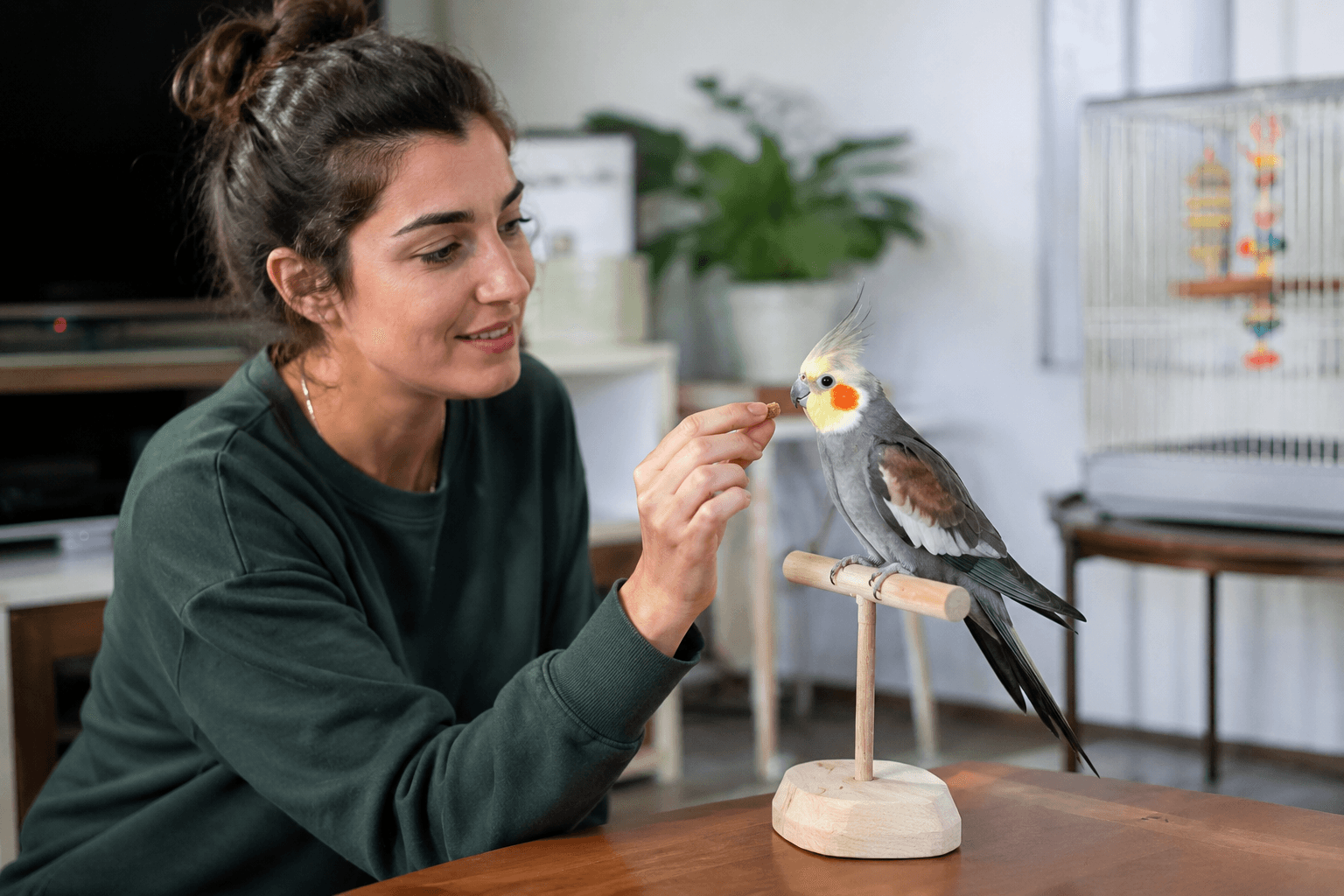
The Most Common Mistakes That Destroy Your Bird's Trust — And How to Avoid Them
Most bird owners don't fail at taming their birds because of a lack of information — they fail because of small mistakes that repeat daily without them even realizing it. 😔
This section is an honest mirror — read it with a critical eye and ask yourself: am I doing any of this?
Forcing and Rushing — The Number One Enemy of Taming
The most widespread mistake among beginner bird owners is rushing the process. And it's understandable — the enthusiasm at the beginning is enormous. 🔥
But your bird's brain doesn't operate the same way ours does. We think: "It's been a week — they should be used to me by now." Your bird thinks: "This large creature keeps pressuring me every single day — I need to stay on high alert at all times."
Common Forms of Forcing That You May Not Even Recognize:
- 🚫 Pushing your hand into the cage despite obvious signs of stress.
- 🚫 Extending training sessions beyond what's needed just to "finish the exercise."
- 🚫 Gripping the bird tightly when they try to fly away instead of letting them retreat.
- 🚫 Attempting to train when the bird is tired, unwell, or after a sudden environmental change.
- 🚫 Repeating the same exercise dozens of times in a single session instead of stopping at 3 to 5 successful repetitions.
What Actually Happens in Your Bird's Brain When You Force Them?
Birds learn through what behavioral scientists call Positive Reinforcement. Every positive experience reinforces a behavior, and every negative experience reinforces fear and avoidance.
When you force your bird, you're not teaching them anything useful — you're teaching them that "when this human appears, expect something unpleasant." And that is the exact opposite of what you want.
💡 The Practical Solution:
- Set one small goal per session — nothing more.
- Always end the session on a success, even a tiny one. Make the last thing your bird does in each session something correct, so they earn their treat and walk away with a positive memory.
- If you feel frustrated, close the cage door and come back later. Your bird genuinely senses your tension. 🧘
Physical Punishment — Why It's a Behavioral Disaster
You might think that a "gentle tap" on the beak or a light push will teach your bird boundaries. The painful truth is: physical punishment with birds teaches nothing except fear. 🚫
Birds simply don't have the capacity to connect punishment with a specific behavior the way we imagine. What actually happens is:
The Real Scenario:
Your bird bites you ← You tap their beak ← They don't understand why that pain occurred ← But they associate your hand with pain ← They become more afraid of your hand ← They bite more to defend themselves.
The result? A vicious cycle that deepens the problem instead of solving it. 🔄
What's the Alternative?
Instead of punishment, use what animal behaviorists call "selective ignoring":
- When your bird bites or screams inappropriately, give zero reaction — no eye contact, no words, no touch.
- Calmly place them on their perch and step away for a few minutes.
- A naturally social bird hates being ignored far more than any physical correction — and this is the only "natural consequence" they truly understand.
🌟 Scientific Fact: Behavioral studies on parrots and companion birds have consistently shown that birds trained exclusively through positive reinforcement display confidence and learning levels up to 3 times higher than those exposed to any form of punishment.
Neglecting Your Bird's Basic Needs During Training
This is a mistake even the most enthusiastic and dedicated owners fall into — they become so absorbed in training that they forget their bird is a living creature with daily needs that never pause. 🌿
Core Needs That Directly Impact Taming Progress:
1. Proper Nutrition:
A hungry bird or one suffering from nutritional deficiency won't focus during training and won't be in the mood to cooperate. Make sure:
- Their diet is varied and specifically appropriate for their species.
- Training treats are offered just before their main meal — when they're eager for food but not desperately hungry.
- Fresh, clean water is available around the clock without exception.
2. Adequate Sleep:
Birds need 10 to 12 hours of sleep in a quiet, darkened environment. A bird deprived of proper sleep will be:
- Irritable and quick to react.
- Less capable of learning new things.
- More prone to unexplained aggression.
Cover the cage with a dark cloth at a consistent time every night — this single habit alone can noticeably improve your bird's behavior within a week. 🌙
3. Mental Stimulation and Enrichment:
A bird living in a bare cage all day develops what experts call chronic boredom, which is one of the leading causes of aggressive behavior, feather plucking, and a wide range of other behavioral problems.
- Provide varied toys and rotate them weekly to keep things interesting.
- Add perches of different diameters and textures to exercise their feet.
- Allow them to hear nature sounds or soft music while you're away.
- Engage with them even outside training time — talking, singing, or simply sitting nearby. 🎶
4. Physical Health:
A bird suffering from hidden pain or an undiagnosed condition will appear aggressive and uncooperative during training for no obvious reason. Always rule out a health issue before judging their behavior.
When to Stop and Give Your Bird a Break
One of the most beautiful skills an experienced owner develops is knowing when to stop. 🛑
This skill is no less important than knowing when to begin. And the good news is that your bird will tell you themselves — if you've learned to read their signals.
Signs of Fatigue and Overstimulation — Stop the Session Immediately If You See:
- 🔴 Repeated flapping and continuous attempts to escape from your hand.
- 🔴 Open-beak breathing that resembles panting.
- 🔴 Refusing treats they were eagerly taking just moments ago.
- 🔴 Consistently turning their head away from you.
- 🔴 Sudden feather puffing combined with motionless sitting.
The Preventive Rule:
Set a maximum session length in advance — 10 minutes for beginners and 20 minutes for more advanced stages — and honor that limit even when the session is going beautifully. Ending at the peak of a great session is the best investment you can make for tomorrow's session.
Finally, remember that taming birds is a shared journey — you deserve to enjoy it too, not feel guilty or pressured. If you find yourself wrestling with a recurring behavioral challenge you simply can't explain, or you notice a sudden shift in your bird's mood and behavior, don't hesitate to book an appointment with a vet at SCOTY — sometimes one expert perspective saves you weeks of uncertainty. 💙
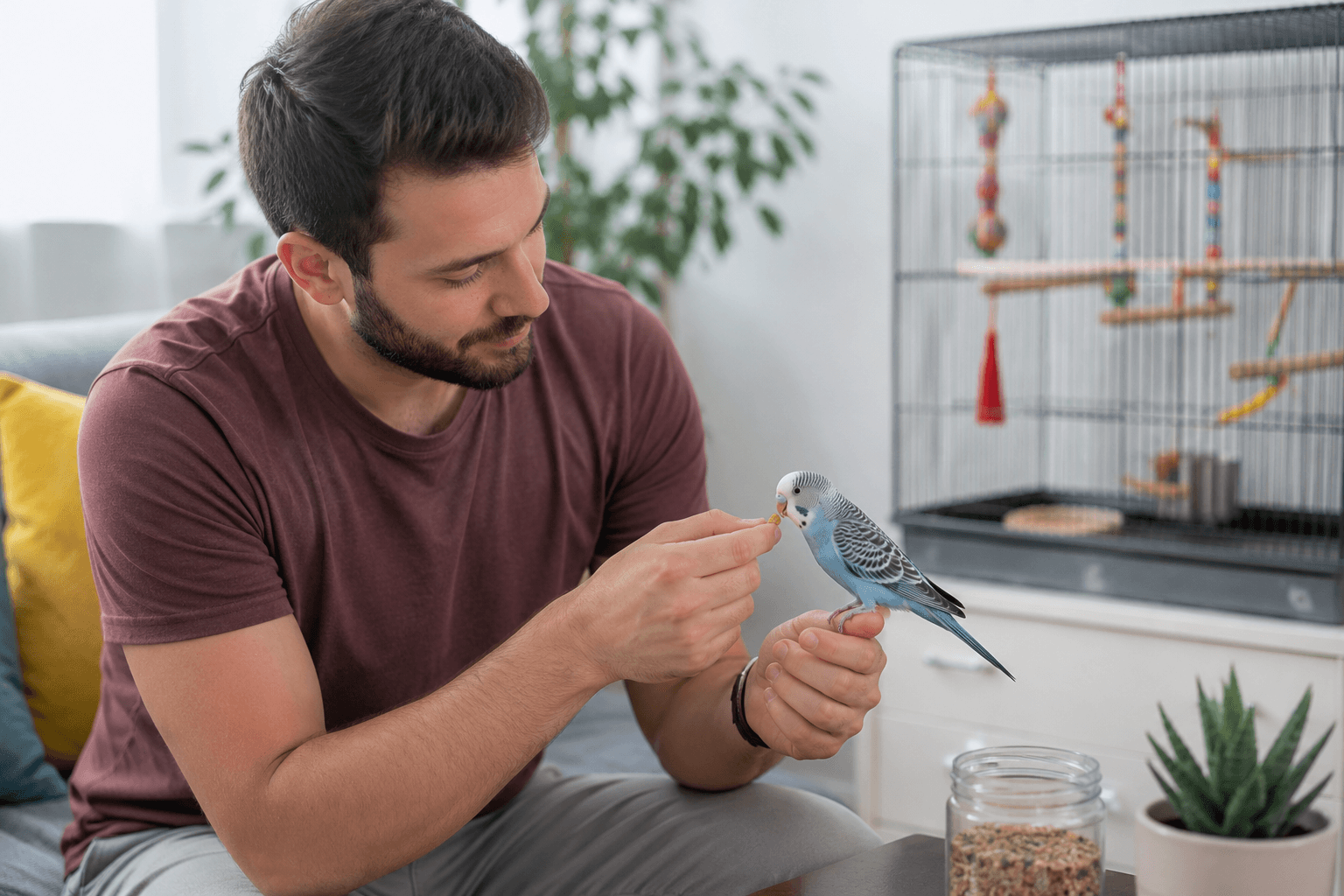
Common Challenges During Taming and How SCOTY Helps You Solve Them
You've made it to the final section, and that tells us you're genuinely committed to this journey with your feathered companion. 🌟
This section is a little different — because it's about the hard moments. Those moments when everything seems to be going well, and then suddenly you hit a wall. Your bird bites, stops progressing, or starts behaving in ways that worry you.
These moments are completely normal. What matters is how you respond to them. 💪
My Bird Is Aggressive and Keeps Biting — Is This Normal?
Biting is one of the most discouraging challenges bird owners face, and it leads many people to abandon their taming birds journey altogether. But before you give up, understand this: biting is always a message, never just random hostility. 🦜
Types of Biting and What They Mean:
1. Fear Biting:
The most common type, especially in the early stages. Your bird isn't inherently aggressive — they're simply scared and using the only weapon they have.
Signs:
- Occurs when you approach suddenly.
- Accompanied by obvious flapping and visible tension.
- Naturally improves as familiarity grows over time.
2. Boundary Biting:
Your bird is simply saying: "That's enough — I want to stop now." This is actually a healthy sign — it means your bird is communicating with you rather than shutting down and freezing from fear.
Signs:
- Occurs after a period of good interaction.
- Relatively gentle, not fierce or drawn-out.
- Stops as soon as you give them space.
3. Hormonal and Nesting Biting:
During breeding season, even the most affectionate birds can suddenly transform into unrecognizable, defensive creatures. This is a completely normal and temporary hormonal shift.
Signs:
- Appears in spring or with changes in daylight hours.
- The bird seeks out hiding spots and guards any corner they've claimed as "their nest."
- Disappears naturally once the season ends.
4. Pain or Illness Biting:
This is the type that demands immediate attention. When your bird suddenly bites with no warning despite being previously gentle and friendly, there may be a hidden physical cause at play. ✋
How to Practically Handle Biting:
- Stay still and don't pull your hand away quickly — fast withdrawal rewards the bite.
- Say "no" in a firm but low voice — never raise your voice.
- Calmly place them on their perch and give them two minutes of space.
- Review the session honestly: was it too long? Did you miss signs of fatigue?
- Don't avoid your bird afterward — continue your daily familiarity routine without added pressure.
My Bird Isn't Progressing Despite Training — What Do I Do?
This moment is deeply frustrating — you put in daily effort, follow the steps, stay consistent, yet your bird seems completely "stuck" in the same place. 😞
Before you feel defeated, know that there are specific, identifiable reasons behind every plateau — and all of them can be addressed.
Reasons Your Bird May Have Stopped Progressing:
First: Jumping Between Stages Too Early
By far the most common reason. You moved from stage two to stage three before your bird was truly ready, and that caused a setback in their confidence.
Solution: Go back a step without hesitation. Stepping back isn't failure — it's intelligent training. 🔄
Second: Inconsistent Routine
You train one day, then skip a week, or change your approach every session. Birds need consistent, predictable repetition to build reliable positive memories.
Solution: 10 focused minutes daily outperforms a single hour-long session every week in cumulative impact.
Third: Environmental Stress
Has anything changed at home recently? A new baby, a new pet, rearranged furniture, increased noise levels? Birds are extraordinarily sensitive to environmental changes and can regress behaviorally because of them.
Solution: Identify what changed and give your bird time to adjust to the new normal before resuming intensive training.
Fourth: An Undiagnosed Health Issue
This is the most serious reason because it's the hardest to detect. A bird experiencing foot pain won't step up on a stick. A bird with a vision problem won't respond normally to your hand movements.
If you've tried everything else and still see no progress, the smartest next step is a consultation with a veterinarian who specializes in birds to rule out any underlying physical cause. 🩺
Warning Signs That Require Immediate Veterinary Attention
No matter what stage of training you're at, every bird owner needs to know these signs — the ones that cannot wait. 🚨
Physical Emergency Signs:
- 🔴 Constantly puffed feathers combined with visible lethargy and no movement — this is not sleepiness, this is illness.
- 🔴 Discharge from the nostrils or eyes of any color.
- 🔴 Changes in the color or consistency of droppings lasting more than 24 hours.
- 🔴 Labored breathing or audible breathing sounds — a genuine emergency requiring immediate action.
- 🔴 Feather plucking or the appearance of bare, bald patches on the body.
- 🔴 Inability to perch or balance on their stand.
- 🔴 Complete loss of appetite for more than 12 hours — birds eat constantly, and stopping is a serious warning sign.
Behavioral Signs That Warrant Professional Evaluation:
- 🟡 A sudden, dramatic personality shift with no obvious cause.
- 🟡 Compulsive, repetitive feather destruction.
- 🟡 Non-stop screaming that continues throughout the entire day.
- 🟡 Refusing their favorite food that they've always loved.
- 🟡 Repetitive circling in one direction — may indicate a neurological issue.
The Golden Rule With Birds:
In the wild, birds instinctively hide signs of illness because a sick bird becomes an easy target for predators. This means that by the time your bird appears visibly unwell, the condition has often already progressed significantly. Don't wait.
How to Continue Your Taming Journey With Confidence Through SCOTY
The journey of taming birds is beautiful — but it isn't always smooth. And in the difficult moments, you need a trusted partner who understands your bird just as deeply as you do. 🤝
That's exactly where SCOTY comes in — the comprehensive online veterinary consultation platform designed specifically for dedicated pet owners like you.
How Your SCOTY Experience Works:
First: Choose Your Own Vet 👨⚕️
At SCOTY, you're never assigned a random doctor. Browse detailed professional profiles of specialized veterinarians, read about their experience and areas of expertise, and choose the one who feels like the right fit for your bird's specific situation. Then book your appointment directly from the calendar in seconds.
Second: Share Every Detail Before the Session 📸
One of SCOTY's most powerful features is the ability to attach photos and videos of your bird's condition before the session even begins. Noticed a behavior you can't quite describe in words? Record it and send it ahead — a video says what words sometimes can't, and the vet reviews everything carefully before your call starts.
Third: A Full Thirty-Minute Session With an Expert ⏱️
Your call with the vet is a full 30 minutes — real, unhurried time to discuss everything that's on your mind. Your bird's behavior, your training plan, health concerns, every question that's been building up. The vet is with you until you're done.
Fourth: An Official Digital Prescription, Instantly 💊
If your bird needs any medication, you'll receive a certified electronic prescription that's ready to download and fill online with complete ease — no clinic trip, no waiting room, no unnecessary hassle.
Fifth: A Complete Medical Record, Always Accessible 📋
Every session is documented into a full case report stored in your bird's medical file within the app. Months or years from now, their entire medical history will be in one organized place, accessible whenever you need it.
Sixth: A Full Week of Free Follow-Up Support 🎁
This is the feature everyone loves most — after your session ends, you receive a free review and follow-up period via chat, available around the clock for a full seven days. Have a quick question at midnight? Notice something new in your bird's behavior? The team is right there. And at the end of that week, you also receive a complimentary follow-up call to make sure everything is moving in the right direction.
Start your journey today by booking an appointment with a vet and give your feathered companion the specialized care they truly deserve. 🐦💛
A Final Word — From One Bird Lover to Another:
Your taming journey isn't a race — it's a story of friendship written one day at a time. One day, you'll be sitting with your bird perched on your shoulder, singing softly in your ear, and you'll look back on every difficult moment and smile.
The patience you invest today is the bank you'll draw from for years of beautiful, unbreakable companionship. 🌟🐦