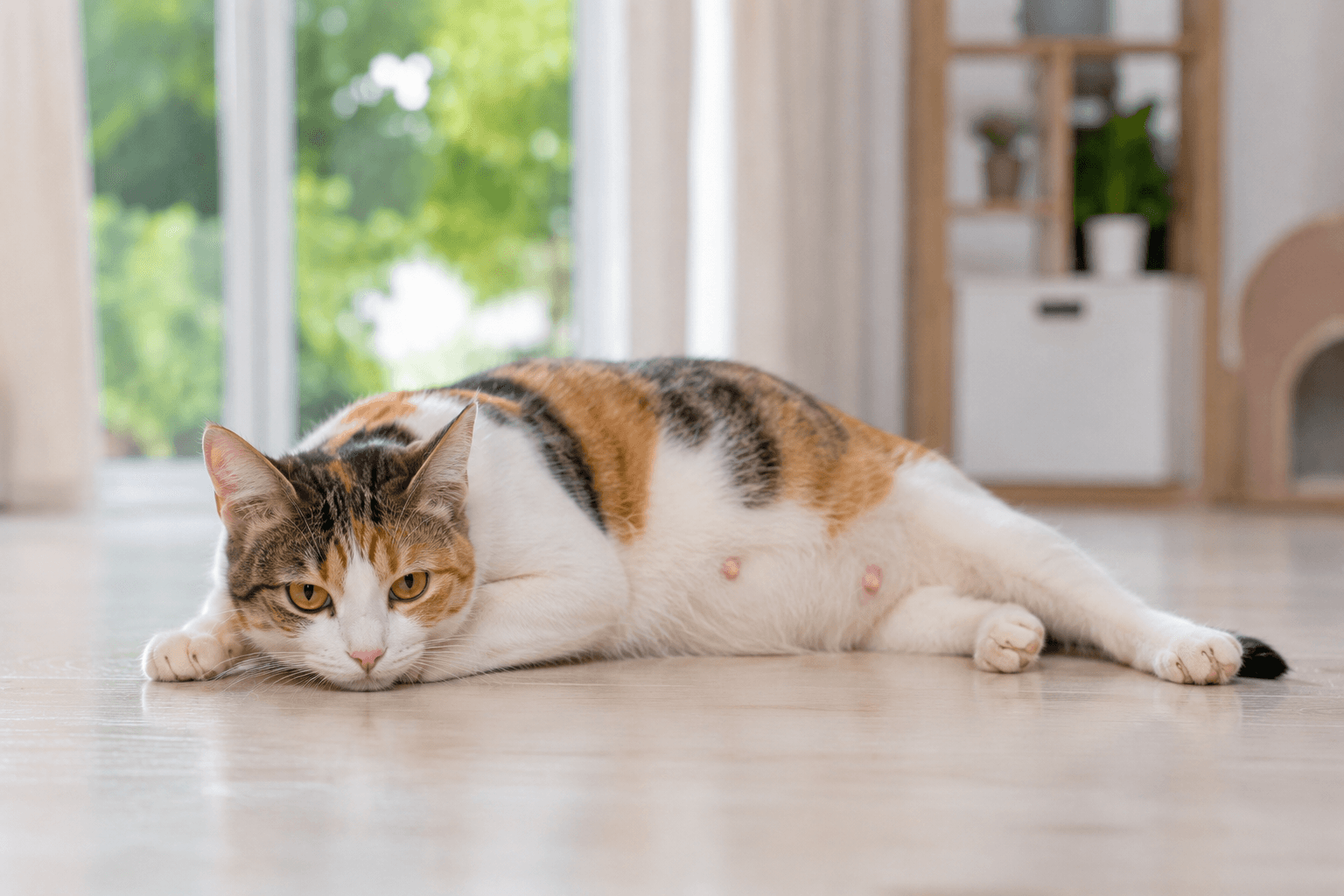
Your cat has become calmer than usual and sleeps for longer stretches, her nipples look more prominent and her appetite has suddenly shifted, leaving you curious and a little anxious: are these pregnancy symptoms in cats?
To put your mind at ease from day one, SCOTY connects you with a specialized vet through remote consultations, so you get trusted, accurate guidance from home.
In this article, we walk you through the physical and behavioral signs that show whether your cat is expecting, what the stages of feline pregnancy look like, and the care and nutrition she needs before giving birth.
If you suspect she’s expecting, start your veterinary consultation now and make sure you’re taking the right steps for her.
Pregnancy Symptoms in Cats During the Early Stages
A cat's pregnancy lasts between 63 and 67 days — less than ten weeks! That means things develop quickly, and the signs that appear each week look completely different from the week before.
Pregnancy symptoms in cats don't all arrive at once. They build gradually, and the earlier you recognize them, the better positioned you are to provide the best possible care from day one.
🔍 The First Physical Changes You'll Notice
In weeks one and two, what's happening is almost entirely internal — much like the early stages of human pregnancy.
But by around week three, the body starts sending signals:
- Nipple reddening and enlargement: Veterinarians call this "pinking up," and it's one of the clearest early signs of pregnancy. Your cat's nipples will turn a deeper shade of pink and become noticeably larger — visible even through thicker fur.
- Tenderness around the abdomen: If you gently touch her belly, you may feel something resembling tiny firm masses — these are the embryos in their earliest stages. Handle with care and avoid any pressure.
- Gradual weight gain: This typically begins around week four, with a total gain of 1 to 2 kilograms by the end of pregnancy, depending on the number of kittens.
💡 Practical tip: If you notice redness of the nipples accompanied by any change in your cat's weight, do not wait—these could be symptoms of other conditions that require checking our article on common diseases by a veterinarian specializing in cats.
🍽️ Changes in Appetite and Behavior — Your Cat Is Telling You Something
Pregnant cats in the early weeks can seem like their personality shifted overnight — and in a hormonal sense, it really has.
On the food front:
- Some cats develop a noticeably increased appetite as early as week three
- Others — just like humans — experience a version of morning sickness in the early weeks and may turn away from their favorite food
- You might notice her suddenly preferring different foods or asking for larger portions
On the behavioral front:
- A marked increase in affection and closeness toward you — as if she's seeking warmth and reassurance 🥰
- Sometimes the opposite: she becomes more withdrawn and prefers solitude
- Sleeping far longer than usual — her body is building new lives, and that demands enormous energy
These behavioral shifts are completely normal and form a core part of pregnancy symptoms in cats that can easily catch an unprepared owner off guard.
🤰 The Belly Grows and the Nipples Transform — Mid-Pregnancy Signs
From week five onward, the changes become far more visible and unmistakable 📅
What you'll notice during this stage:
- Clearly visible belly expansion: Not just a subtle fullness, but a real widening — especially along the sides. If you look at your cat from above, her waist will have broadened noticeably.
- Feeling fetal movement: By weeks six or seven, placing your hand gently on her belly may allow you to feel the faintest flutters — a deeply moving moment for any owner experiencing it for the first time 🐾
- Nipple discharge: Some cats begin producing small amounts of milk or a clear fluid toward the end of pregnancy.
- Difficulty self-grooming: As her belly expands, you'll notice she can no longer easily reach her tail or lower abdomen — offer her a helping hand with gentle brushing.
🌟 Something beautiful to know: Around week six, pregnant cats begin searching for their "nest" — you'll find her exploring cabinet corners, burrowing into folded laundry, and seeking out quiet, warm, secluded spaces. This is completely natural maternal instinct, not strange behavior at all.
🏥 When Should You First See a Vet?
This is one of the most common questions among cat owners — and the right answer is: as early as possible after suspecting pregnancy.
Why does early veterinary attention matter so much?
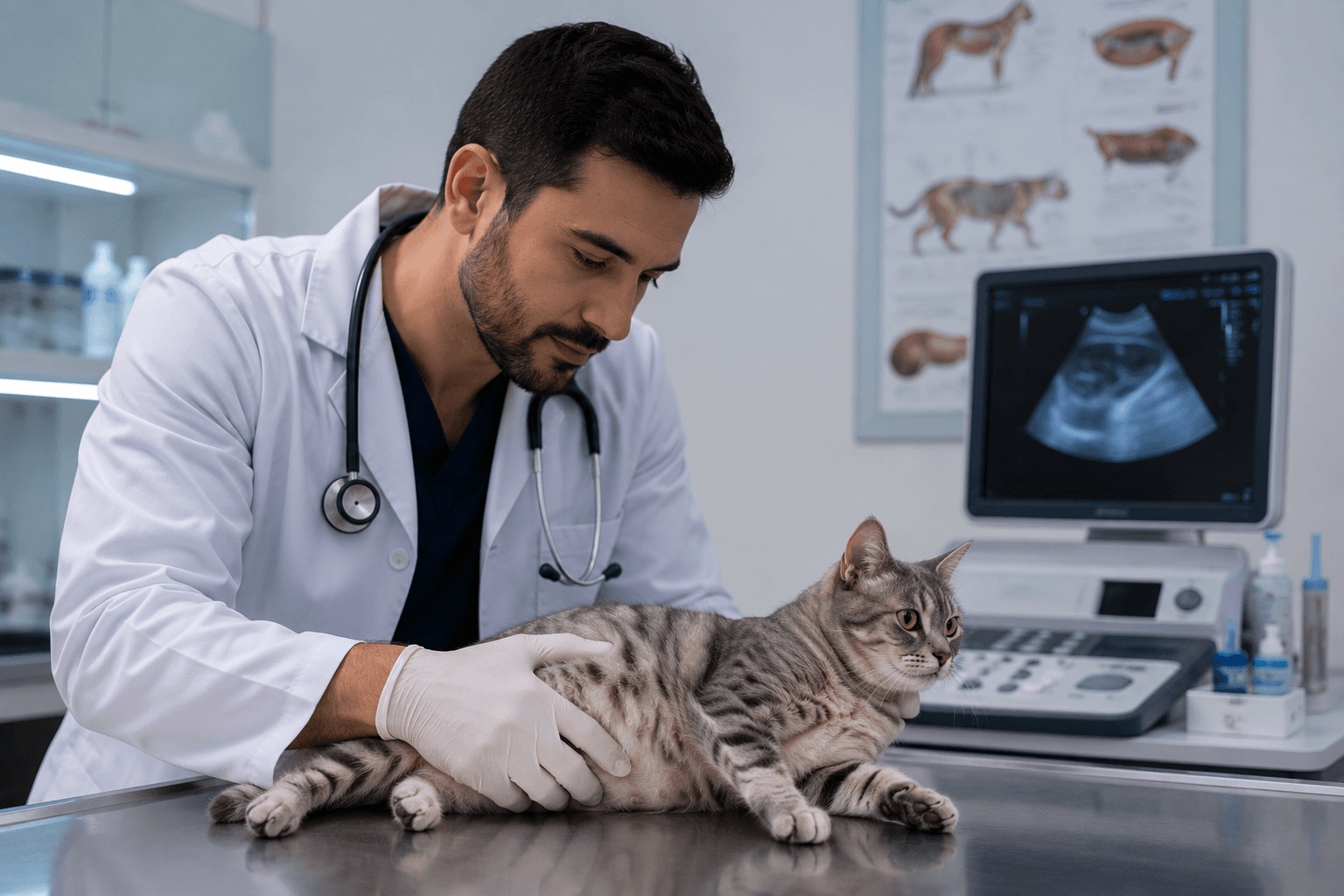
- Confirming pregnancy via ultrasound, which can detect embryos from as early as week three
- Checking the health and number of fetuses — and catching rare complications like ectopic pregnancy early
- Starting the right nutritional plan for the current stage
- Establishing a health baseline for the mother and monitoring any changes that may require intervention
If a veterinary clinic for cats isn't easily accessible, or if you'd prefer an initial consultation from the comfort of your home, SCOTY connects you with an experienced feline veterinarian in minutes — browse doctor profiles, choose the specialist who feels right for you, and book your appointment directly from the calendar.
You can also attach photos or short videos of your cat before the session begins, so the vet can review her condition and arrive fully prepared for your consultation. 🩺
Book appointment now and start this pregnancy journey on the right foot 🐾
A Week-by-Week Guide to Cat Pregnancy — The Complete 63-Day Journey
Sixty-three days may sound brief on paper, but in reality it's an intensely transformative journey — one in which your cat's body changes in remarkable ways 🐾
Every week brings new physical, behavioral, and instinctual developments. The more you understand what's happening at each stage, the more confidently and caringly you can support your cat through it all.
Pregnancy symptoms in cats evolve rapidly as the weeks progress — and what seems unusual in one week may actually be a perfectly healthy sign that everything is unfolding exactly as it should.
🤫 Weeks 1–3: The Silent Pregnancy
This phase earns its name for good reason — almost nothing on the outside hints at what's happening within.
What's happening inside your cat's body?
Immediately after fertilization, the eggs travel to the uterus and begin implanting in its walls within a matter of days. At this stage, each embryo is no larger than a grain of rice — yet the body is already working at full capacity to support them.
What you might notice in your cat:
- Unusual quietness and a tendency to sleep far more than normal 😴
- A reflective, inward quality to her gaze — as if she's contemplating something only she can sense
- Subtle fluctuations in appetite that may pass without you noticing
- No visible change in belly size or nipple appearance yet
💡 Important note: If you know your cat has mated and you suspect pregnancy, week three is the ideal time for a first check — ultrasound imaging can reliably detect embryos from this point onward.
🌸 Weeks 4–5: "The Pink Moment" — Pregnancy Symptoms in Cats Become Unmistakable
This is where things start shifting in ways that simply can't be ignored 🌟
The most notable developments during these weeks:
- Full "Pinking Up": The nipples deepen to a vivid rose-pink and become clearly prominent — even through thick fur, they're hard to miss
- The belly begins to widen: Not dramatically yet, but if you look at your cat from above, that characteristic feline waistline has softened and spread
- Appetite noticeably increases: Her body is now fueling rapidly developing embryos, and larger portions are completely expected
- Increased attachment to you: She may follow you from room to room, seeking more contact and physical warmth 🥰
During these specific weeks, pregnant cats often behave in ways that can be confusing to their owners. Suddenly, the reason for the cat's irritability becomes clear: it is due to fluctuating hormones, not a genuine behavioral issue. She may suddenly become aloof and then turn around to seek affection; both behaviors are completely normal at this stage.
What a vet check during this phase can reveal:
- A more precise count of fetuses via ultrasound
- Individual fetal heartbeats
- Confirmation that development is progressing normally, with no rare complications
🏠 Weeks 6–7: Your Cat Is Building Her Nest
This is the phase where instinct takes over in the most visible and touching way 🐱
The "Nesting Behavior" Phenomenon:
You'll notice your cat exploring the house differently — slipping into closets, pawing through folded blankets, circling quiet corners and warm, enclosed spaces. This isn't strange behavior in the slightest. It's a deep maternal drive preparing her for the birth ahead.
Visible physical changes during this stage:
- The belly is now unmistakably large — your once-nimble cat now moves with slower, heavier steps 🐢
- Noticeable difficulty grooming herself, particularly her tail area and lower back
- Sleep increases substantially while physical activity naturally decreases
- You may hear soft, low vocalizations — gentle meows or a low hum — her way of expressing the weight of this moment
How can you help her during these weeks?
Don't discourage her from exploring potential nesting spots. Instead, provide a designated birthing box in a quiet location and introduce it at least two weeks before her due date. If you wait until the last moment, she may reject it entirely and choose your wardrobe instead 😅
Line the box with soft, washable fabric and place it away from household noise, children, and other pets.
Understanding cat language becomes more important than ever at this stage—your cat communicates with you through her entire body and vocalizations, and understanding what she is trying to convey makes the pregnancy experience smoother for both of you
🍼 Weeks 8–9: Preparing for Birth
The final days before delivery are filled with signs telling you clearly and unmistakably: the time is near ⏰
Signs that typically appear 24–48 hours before labor:
- A drop in body temperature: If you measure your cat's temperature and find it below 37.8°C (100°F), labor is likely within 24 hours
- Sudden loss of appetite: After weeks of enthusiastic eating, she may abruptly turn away from food entirely
- Visible restlessness: Pacing back and forth, unable to settle in any one place
- Constant licking of the abdominal and genital area: A clear signal that labor is approaching
- Clear vaginal discharge: Typically odorless and colorless — normal at this stage
⚠️ When to contact a vet immediately:
If more than two hours pass between kittens, if you see dark-colored or foul-smelling discharge, if your cat appears to be in severe pain without any progress — these are situations requiring urgent veterinary attention.
In these critical moments, SCOTY is your first call — connecting you with an experienced vet within minutes. Attach a short video of your cat's condition before the call begins, and the vet will have already assessed her situation before your session even starts. Book a consultation or start an emergency session directly 🩺
Preparing Your Home and Caring for Your Pregnant Cat — Nutrition, Environment, and Daily Care
The right care during pregnancy is every bit as important as the medical care — it is, in fact, the foundation upon which both the mother's and kittens' health is built 🏡💕
Your pregnant cat needs more than food and water from you. She needs a calm environment, thoughtful nutrition, and daily attentiveness that makes her feel safe and deeply cared for. And you, in turn, need to know exactly what to do — and what to avoid — at each stage of her pregnancy.
Pregnancy symptoms in cats aren't simply signs to observe passively. They are meaningful signals telling you what her body needs week by week — and understanding them allows you to make smarter, more precise decisions about her nutrition and care.
🍗 The Ideal Diet for a Pregnant Cat — What She Should Eat and What to Avoid
Feeding a pregnant cat isn't simply about giving her more of the same — it requires a meaningful shift in the quality and composition of what she eats 🥩
What to add to her diet:
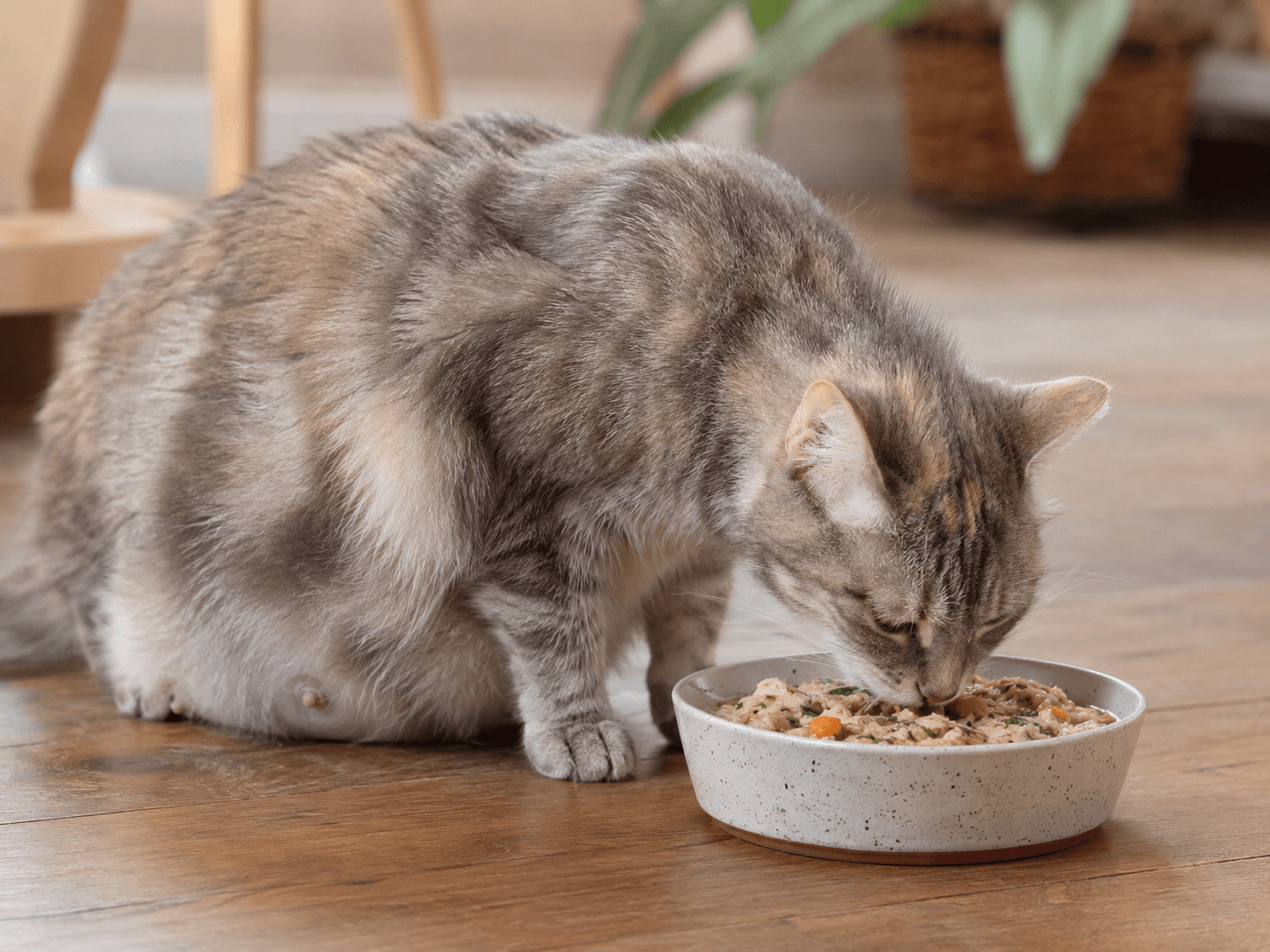
- High-quality protein: Cats are obligate carnivores, and during pregnancy their protein requirements increase significantly to support fetal development. Cooked chicken, fresh fish, and premium kitten food are all excellent options — kitten formulas are particularly well-suited during pregnancy due to their higher caloric and nutrient density
- Calcium and phosphorus: Essential for building strong fetal bones and maintaining the mother's dental health — found in adequate amounts in high-quality commercial cat food
- Omega-3 fatty acids: Support fetal neurological development and help maintain the mother's coat condition during this physically demanding period
- Consistent hydration: Fresh water should always be available and replenished regularly throughout the day
What to avoid entirely:
- ❌ Liver in large quantities — excessively high in vitamin A, which can be harmful to developing fetuses
- ❌ Raw or undercooked meat — the risk of toxoplasmosis is real and poses a serious threat to fetal development
- ❌ Large amounts of dairy products — many cats are lactose intolerant, and dairy can trigger digestive upset and diarrhea
- ❌ Onions, garlic, grapes, and raisins — toxic to cats under any circumstances, and significantly more dangerous during pregnancy
- ❌ Sudden dietary changes — any transition should happen gradually over 7 to 10 days to avoid gastrointestinal distress
How much should she eat?
- Weeks 1–4: Approximately the same as her normal intake
- Week 5 onward: Gradually increase portions, working toward roughly 50% more than her usual amount by the final week
- In the final weeks: Smaller, more frequent meals are preferable to two large ones — her growing abdomen presses against her stomach and makes large meals uncomfortable
For guidance that extends beyond the birth itself, you'll find a comprehensive resource on the best food for nursing cats — because the mother's nutritional needs remain just as critical throughout lactation.
💊 Medications and Vaccines During Pregnancy — What's Safe and What's Not
This is an area where many well-meaning cat owners make mistakes — administering a routine medication or supplement without realizing it could pose a genuine risk to the developing kittens 😔
The golden rule: No medication, supplement, or antiparasitic treatment without veterinary guidance during pregnancy — including products your cat used safely before she became pregnant.
Vaccinations:
- Ideally, all vaccinations should be brought up to date before pregnancy, not during
- Modified Live Vaccines are contraindicated during pregnancy as they may negatively affect fetal development
- If your cat requires a vaccine during pregnancy for compelling medical reasons, the type and timing will be determined by her vet with careful consideration
Parasite treatments:
- Some flea and worm treatments are safe during pregnancy; others are strictly contraindicated
- Never use any over-the-counter product without veterinary clearance first — even products marketed as gentle or natural
Nutritional supplements:
- Excess vitamin A is dangerous to fetal development — avoid supplementing it unless specifically prescribed
- Omega-3 supplements are generally considered safe, but only at appropriate, vet-recommended doses
- Calcium over-supplementation can sometimes interfere with uterine contractions — never administer it arbitrarily
🔎 If you are unsure about any medication or supplement, you can contact an animal vet number who can answer your questions accurately without the need to leave your home.
🛏️ Setting Up the Birthing Space — Everything You Need to Prepare
A proper kittening box isn't a luxury — it's a necessity that gives your cat a sense of security and makes the birth safer and calmer for everyone involved 📦
How to set up the ideal birthing box:
- Size: Large enough for your cat to stretch out comfortably alongside her newborns, but not so spacious that the kittens can wander and become separated
- Sides: High enough to keep newborns from climbing out in the early days, with a low side opening that allows the mother to enter and exit with ease
- Bedding: Layers of old towels or soft, washable fabric — plan to replace everything immediately after the birth
- Location: A quiet, warm spot away from household noise, children, and other animals
When should you introduce the box?
Around week six — give your cat at least two weeks to explore it and claim it as her own before her due date. Introducing it at the last minute often results in her choosing an alternative location entirely, like the inside of your closet 😅
What to have ready close to the due date:
- ✅ Clean, small towels
- ✅ Sterile scissors (for emergencies only — to be used only under veterinary guidance)
- ✅ A small digital scale for weighing newborns
- ✅ A thermometer for monitoring the mother's temperature
- ✅ Your vet's contact information saved and SCOTY installed and ready on your phone
The proper way to raise kittens begins with these preparatory moments—as the environment in which they are born significantly influences their psychological and physical health during the first few weeks of their lives.
🚨 Warning Signs That Require Immediate Veterinary Attention
Not every pregnancy proceeds without complications, and certain signs — if overlooked — can place both the mother and her kittens in serious danger ⚠️
Stop hesitating and seek help immediately if you notice:
- 🔴 Dark vaginal discharge (brown or black in color) or discharge with an unpleasant odor at any point during pregnancy
- 🔴 Any amount of bleeding during the pregnancy
- 🔴 A sudden and complete loss of appetite lasting more than 24 hours during the middle stages
- 🔴 Body temperature above 39.5°C (103°F) or below 37°C (98.6°F) — outside the expected pre-labor temperature drop
- 🔴 Severe abdominal rigidity or bloating accompanied by visible discomfort
- 🔴 Strong contractions continuing for more than 30 minutes without the delivery of a kitten
- 🔴 More than two hours passing between the birth of each kitten during active labor
- 🔴 A kitten partially visible at the birth canal for more than 10 minutes without being fully delivered
In any of these situations, time is the most precious resource you have.
With SCOTY, you can reach an experienced veterinarian within minutes — attaching photos or video of your cat's condition before the call begins, so the vet arrives at your session fully informed and prepared. Following the consultation, you'll receive a certified digital prescription ready to download and fill immediately, with every detail of your cat's case documented in her permanent medical file within the app. 📋
Book a consultation now — don't leave any concerning sign without an answer. Your cat deserves the very best. 🐾
After the Birth — Caring for the Mother and Kittens in the First Weeks
They're finally here 🐾🐾🐾
That moment when you first see the kittens — tiny, pink, and blindly searching their way toward their mother — is one of the most moving experiences any cat owner will ever have. But once the birth is over, an entirely new chapter begins, one that asks something different of you and requires just as much care and attention as the pregnancy itself.
The first weeks after birth are the most sensitive in a kitten's life, and the most physically demanding for the mother. Understanding what's happening during this period will make the difference between an exhausting experience and one that feels genuinely beautiful and rewarding.
🌅 The First Hours After Birth — What to Expect
The first 24 hours are eventful, and the wisest thing a caring owner can do is observe attentively rather than intervene unnecessarily 👀
What the mother does immediately after delivery:
- She cleans each kitten the moment it arrives — licking away the amniotic sac from the face to allow the newborn to breathe
- She severs the umbilical cord with her teeth, naturally and precisely
- She vigorously licks each kitten to stimulate breathing — it may look rough, but she knows exactly what she's doing
- She consumes the placenta — this is entirely normal instinctive behavior that replenishes minerals and proteins her body has expended
What your role is in these moments:
- ✅ Observe from a respectful distance without interfering — the mother rarely needs assistance
- ✅ Ensure every kitten reaches a nipple and nurses within the first hour — the colostrum produced in these early hours carries vital immunity that cannot be replicated or replaced
- ✅ Count the kittens and confirm the number of placentas matches the number of births — a retained placenta is a medical emergency
- ✅ Monitor the mother for signs of continuous or heavy bleeding
Signs requiring immediate attention after birth:
- 🔴 A kitten that isn't breathing or moving, and the mother hasn't successfully stimulated a response
- 🔴 A mother who consistently rejects and pushes away a specific kitten
- 🔴 Bright red bleeding from the mother that continues beyond 10 minutes
- 🔴 A mother who remains motionless and unresponsive for an extended period after delivery is complete
And if you notice your cat developing unusual eye discharge during pregnancy, know that treating cat eye discharge during this period requires specialist guidance to ensure the safety of both the mother and her developing kittens.
🍼 Supporting the Mother Through Nursing
Nursing is the most demanding and physically taxing responsibility your cat faces after giving birth — and she needs your full support to do it well 💕
Natural nursing — how to know it's going well:
Each kitten should nurse approximately every two hours during the early days. Signs that nursing is progressing healthily:
- The kitten latches firmly onto the nipple and produces a clearly audible suckling sound
- The kitten's abdomen looks round and full after feeding
- Kittens sleep peacefully between feedings without persistent crying
- Weight increases noticeably and consistently day by day throughout the first week
If the mother rejects a specific kitten:
This occasionally happens when a kitten is weak or unwell — the mother senses this instinctively. In this situation:
- Gently try bringing the rejected kitten close during nursing sessions with the others
- If rejection continues, bottle feeding with a formula specifically designed for newborn kittens may become necessary
- Never use cow's milk — it is nutritionally inappropriate for kittens and causes serious digestive distress
Feeding the nursing mother:
A lactating cat's body requires roughly double its usual caloric intake. To support this:
- Allow free feeding throughout the day — no portion restrictions during this period
- Continue with the same high-protein diet she was on during pregnancy
- Fresh water must always be available and generously supplied — lactation depletes her fluid reserves significantly
🏥 Kitten Health — When Do They Need Their First Vet Visit?
Newborn kittens arrive with maternal immunity from the colostrum they received, but they still need careful, attentive monitoring from day one 🐱
Essential care timeline for the kittens:
| Stage | What to do |
|---|---|
| Days 1–3 | Confirm every kitten is nursing and gaining weight |
| Week 2 | Eyes will begin opening naturally — never force them |
| Weeks 3–4 | Kittens begin walking and exploring — create a safe, contained space |
| Weeks 4–6 | Begin introducing soft wet food alongside nursing |
| Weeks 6–8 | First full veterinary examination and initial vaccinations |
| Weeks 8–12 | Complete weaning and remaining vaccinations |
Concerning signs in newborn kittens that require veterinary attention:
- 🔴 Persistent, loud crying for more than one hour — typically signals hunger, cold, or pain
- 🔴 No weight gain, or weight loss after the first day
- 🔴 Abnormal stool or urine
- 🔴 Muscle rigidity or excessive limpness
- 🔴 Eyes that haven't opened by the third week
Kittens who receive attentive, consistent care in these early weeks grow into emotionally balanced and affectionate companions — and cats get used to their owner is directly connected to the quality of nurturing they received during this foundational stage of life.
✂️ Preventing Future Pregnancies — Spaying and Family Planning
Once nursing ends and the kittens are fully weaned, many owners face an important question: what about the next pregnancy? 🤔
An unspayed cat can become pregnant again within just a few weeks of giving birth — some even enter a new reproductive cycle while still nursing. This places enormous strain on her body and significantly compromises her long-term health.
The options available to you:
- Spaying: The most widely recommended and safest long-term solution. Typically performed a few weeks after weaning is complete, spaying dramatically reduces the risk of uterine, ovarian, and mammary cancers
- Preventing mating access: Keeping your cat away from males during heat cycles — a temporary measure that is stressful for her and unsustainable over time
- Hormonal treatments: Used in specific situations but generally not the preferred medical option due to potential side effects
💡 When is the ideal time to spay?
Most veterinarians recommend waiting until 8 to 12 weeks after delivery — once weaning is complete and the mother's body has fully recovered its normal state.
🌟 Your Trusted Companion Throughout This Entire Journey
From the very first suspicion of pregnancy, through all nine weeks, and into the care of newborn kittens — this journey deserves a reliable medical partner who is truly there for you at every step.
SCOTY was built precisely for moments like these — a complete veterinary clinic in your pocket, available whenever you need an answer:
- 📋 Browse specialist vet profiles and choose the doctor who feels right for your cat
- 📅 Book your appointment directly from the in-app calendar in seconds
- 📸 Attach photos or video of your cat before the session so the vet can review her condition in advance
- 📞 A full 30-minute consultation to discuss everything in depth, without feeling rushed
- 💊 A certified digital prescription, ready to download and fill immediately after your session
- 🗂️ Complete documentation of your cat's case saved permanently in her medical file within the app
- 💬 And most importantly: a full week of free follow-up via chat, available around the clock — plus a complimentary follow-up call included
Because your cat doesn't deserve anything less. 🐾