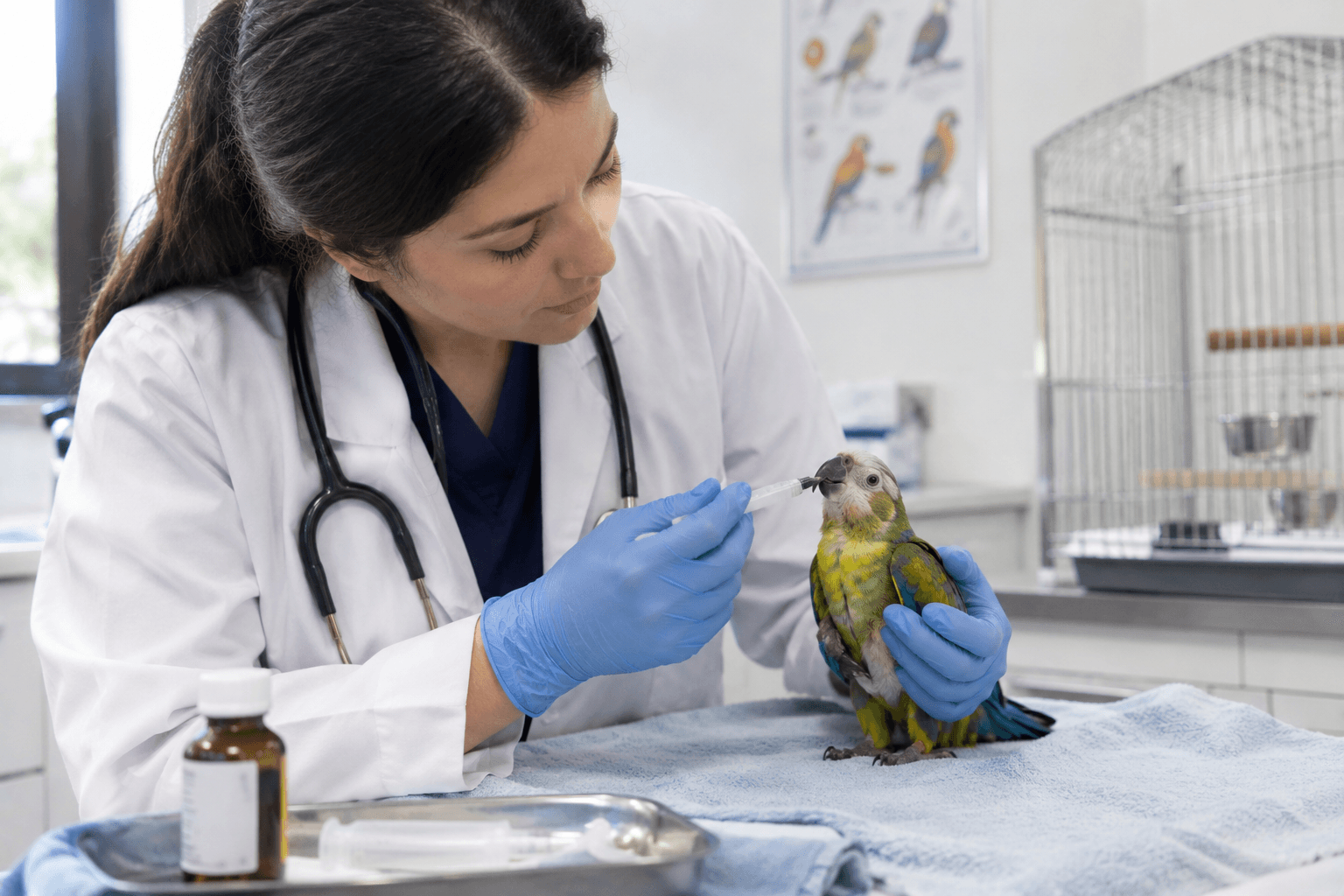
Section One: Your Bird Is Different — Why It Needs a Specialist 🐦
The moment your small bird flutters its wings inside the cage and lets out its signature morning call, silence transforms into music and your home comes alive in the most beautiful way.
Pet birds are not just decorative companions — they are intelligent, emotional, and remarkably sensitive creatures. Anyone who lives with them knows exactly how worrying it can be when your bird seems different: unusually quiet, puffed-up feathers, or refusing to eat.
And that’s when the biggest question begins: Who do I ask? How do I know if my bird is truly okay?
The truth is that most veterinarians do not specialize in birds — and this precise specialization is what makes the difference between an accurate diagnosis that saves your bird’s life and a guess that may do more harm than good.
This article is your complete guide — from one bird lover to another — covering everything you need to know about your bird’s health, and how to find a real bird veterinarian who truly understands this beautiful, tiny world.
Section One: Your Bird Is Different — Why It Needs a Specialist 🐦
If you believe that any general veterinarian can treat your bird the same way they treat cats and dogs, you are not alone in thinking this — but this belief could cost your bird its health.
Birds are different inside and out, and the way they get sick and recover differs fundamentally from other animals.
🧬 A Bird’s Body: A Completely Different World
Imagine trying to read a book written in a language you don’t know — that’s exactly what happens when a non-specialized vet tries to diagnose a sick bird.
Birds differ anatomically in the most fundamental ways:
- The Respiratory System: Birds breathe in a completely different way from mammals — they have air sacs instead of traditional lungs, which makes respiratory diseases far more dangerous and much harder to diagnose accurately.
- The Skeletal System: A bird’s bones are hollow and incredibly thin — meaning fractures can happen with frightening ease, but they also heal differently and require specialized expertise to manage properly.
- Concealing Illness: This point is critically important — birds instinctively hide signs of sickness in the wild because a weak bird becomes easy prey. Your pet bird carries this same instinct even inside the cage. In other words: by the time you notice your bird seems unwell, it may have been sick for days or even weeks.
- Fast Metabolism: A bird’s heart pumps blood at a staggering speed — a small parakeet’s heart beats around 250 times per minute. This rapid metabolism means critical conditions can escalate very quickly.
- Body Temperature: Birds require a higher internal body temperature than humans (between 40–42°C / 104–107°F), and any drop below this range is a serious medical warning sign.
All of these anatomical differences mean that medication dosages, anesthesia protocols, and even the physical examination itself — are all entirely different from what a general vet is trained to handle.
⚠️ Common Mistakes Bird Owners Make
Through our community of bird owners on SCOTY, we’ve noticed the same mistakes appearing again and again — mistakes that can be genuinely dangerous:
❌ Mistake #1: Waiting for It to “Get Better on Its Own”
A bird sitting hunched in the corner of its cage with puffed feathers and half-closed eyes is not just “a little tired.” That bird is actively fighting an illness and desperately needs help.
❌ Mistake #2: Visiting a Vet Who Doesn’t Specialize in Birds
Many excellent veterinarians who are brilliant with cats and dogs openly admit they don’t have sufficient expertise with birds. The solution isn’t to blame them — the solution is to look for a dedicated veterinarian for birds from the very beginning.
❌ Mistake #3: Using “Trial” Medications Found Online
What works for your neighbor’s parrot could be lethal for your bird. Drug dosages are calculated precisely based on your bird’s weight — which might be as little as 30 grams. A difference of a single milligram can be fatal.
❌ Mistake #4: Ignoring Behavioral Changes
Parrot behavior often changes before any physical symptoms appear. A parrot that suddenly stops talking, becomes aggressive without obvious cause, or refuses to leave its cage — these are messages that must never be ignored.
❌ Mistake #5: Relying on WhatsApp Group Advice
Bird owners share a genuine love for their pets, but love cannot replace medical expertise. What worked for one bird does not necessarily mean it will produce the same results for yours.
🔍 How to Tell When Your Bird Is Sick
Birds are experts at hiding illness — but they leave subtle clues for those who know how to read them. Here are the early warning signs you should know by heart:
🔴 Emergency Signs — Act Immediately:
- Difficulty breathing or open-mouthed panting
- Loss of balance or falling off the perch
- Bleeding from anywhere on the body
- Seizures or involuntary movements
- Loss of consciousness or unresponsiveness
🟡 Signs Requiring Urgent Consultation:
- Puffed feathers for extended periods, especially with eyes closed
- Sudden refusal to eat or drink for more than 24 hours
- Droppings that have changed in consistency or color (very dark green, red, or pure white)
- Discharge from the nostrils or eyes
- Sudden feather loss outside of normal molting season
- Unusual sounds during breathing (wheezing or clicking)
🟢 Signs Worth Monitoring Closely:
- Noticeable decrease in activity levels
- Changes in sleep patterns
- Refusing to stand on both feet simultaneously
- Abnormal curving of the beak or overgrown nails
💡 Golden Tip: Spend just 5 minutes every morning observing your bird. This simple habit will help you catch any change on day one — rather than a week later when the situation has become critical.
Truly understanding your bird’s body and behavior is the very first step on the path of a responsible and caring bird owner. In the next section, we’ll dive deep into the most common diseases affecting pet birds — and how to recognize them before they spiral out of control.
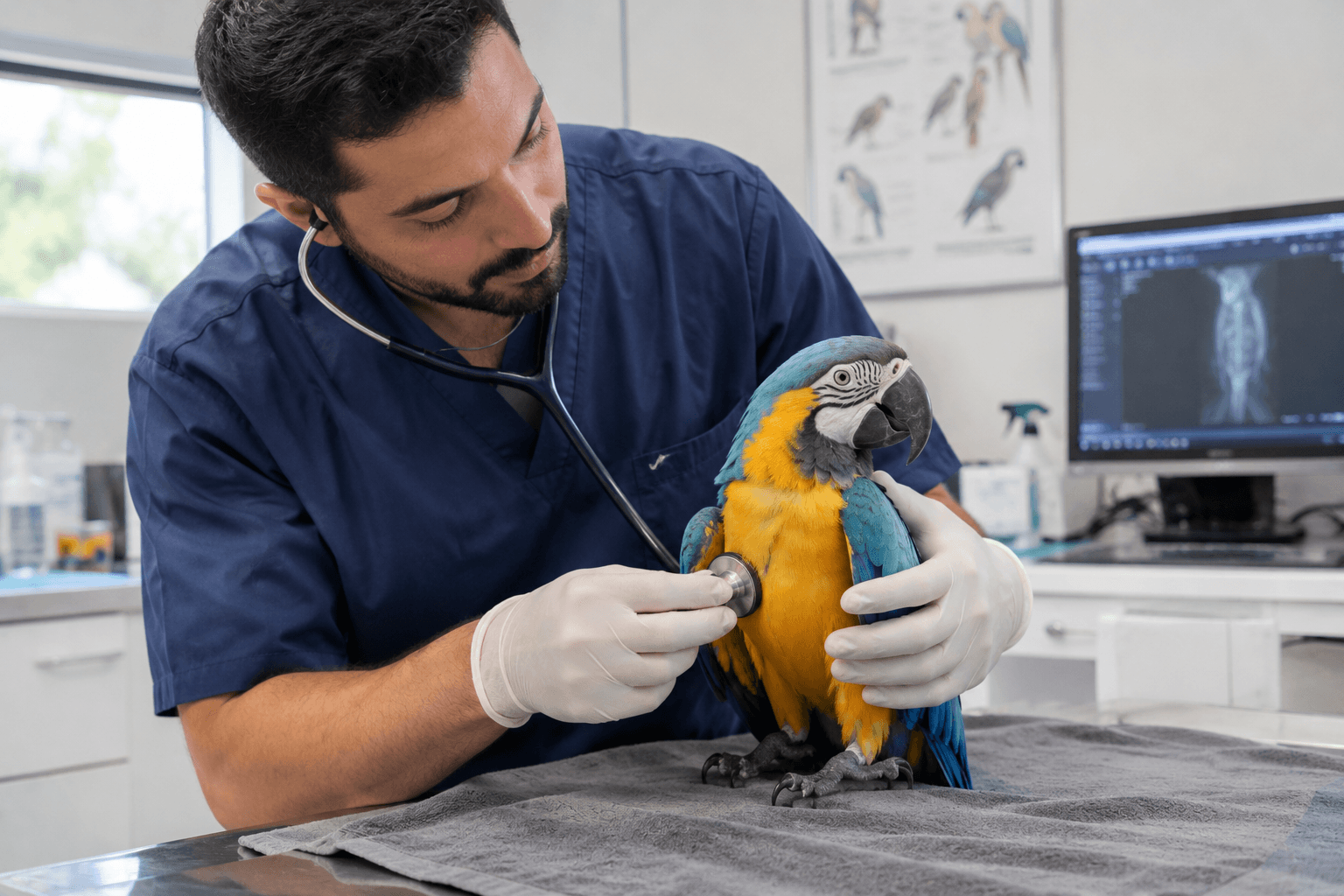
Section Two: The Most Common Diseases in Pet Birds 🏥
Knowing which diseases can affect your bird isn’t meant to frighten you — it’s the most powerful tool you have as a responsible bird owner. Many of these conditions are completely treatable when caught early, but they can become life-threatening when that first warning sign is ignored.
Let’s walk through the most important bird health conditions in clear, practical terms.
🫁 Respiratory Diseases
The respiratory system is the most vulnerable in pet birds, and also the most dangerous — because a bird simply cannot hold on for long when breathing becomes difficult.
The Most Common Respiratory Conditions:
- Air Sacculitis: The most common respiratory disease in pet birds, usually caused by bacteria or fungal infections. Its earliest sign is a faint crackling sound during breathing — so subtle you might miss it at first.
- Psittacosis (Chlamydiosis): A serious bacterial disease that is critically important because it can be transmitted to humans. It causes breathing difficulty, nasal discharge, and severe lethargy. If you notice these symptoms, avoid handling your bird with bare hands and contact a bird veterinarian immediately.
- Aspergillosis: A fungal infection that attacks the lungs and air sacs. It thrives in damp cages, poor ventilation, or in birds experiencing significant stress. Affected birds appear sluggish and breathe with noticeable difficulty.
- Colds and Sinus Infections: Yes, your bird can catch something that resembles a common cold — nasal discharge, frequent sneezing, and an altered breathing sound.
⚠️ Remember: Any breathing difficulty in birds is a medical emergency, not a “wait and see” situation. A bird opening its beak to breathe has already reached an advanced stage of respiratory distress.
🪶 Feather Loss and Skin Conditions
When you find your bird’s feathers scattered across the bottom of the cage in unusual amounts, the worry begins. But feather loss isn’t always a catastrophe — what matters is understanding the real cause behind it.
Causes of Feather Loss — From Normal to Serious:
🟢 Completely Normal:
- The annual molting season, which lasts a few weeks each year
- New feather growth after molting (you’ll notice small “pin feathers” that look like tiny quills)
🟡 Worth Monitoring:
- Feather plucking — a behavioral issue indicating boredom, loneliness, or significant anxiety
- Mites or external parasites causing persistent itching
🔴 Requires Immediate Veterinary Attention:
- Bald patches with redness or skin sores
- Sudden and widespread feather loss outside of molting season
For a detailed breakdown of causes and solutions, the dedicated guide on treatment of feather loss in birds walks you through everything step by step.
🫀 Digestive System Problems
The digestive system is a mirror of your bird’s overall health — and digestive issues are often the first visible sign of a deeper underlying problem.
The Most Common Digestive Problems:
- Diarrhea: Watery, unformed droppings — which may be caused by a sudden dietary change, psychological stress, or a bacterial infection. If it persists for more than 24 hours, consult a specialist.
- Crop Impaction: The crop is the pouch in your bird’s neck where food is stored before digestion. When it becomes blocked, the bird stops eating and you may feel a hard lump in the neck area. This is a medical emergency.
- Internal Parasites: Including worms or giardia — these cause gradual weight loss even when the bird appears to be eating normally.
- Food Poisoning: Avocado, chocolate, and garlic are perfectly normal foods for us but dangerously toxic to birds. We’ll cover this in much more detail in the nutrition section.
💡 Practical Tip: Check the bottom of the cage daily. A healthy bird’s droppings consist of three components: a solid part (green or brown), white urates, and a clear liquid portion. Any change in this pattern is your bird’s way of sending you a message.
🦠 Infectious Diseases and Parasites
Birds sometimes share living environments, and they are susceptible to a range of infectious diseases that can spread rapidly among multiple birds in the same household.
The Most Common Infectious Diseases:
🔹 Avian Pox:
Appears as wart-like growths or crusty scabs around the beak, eyes, and feet. It spreads through mosquitoes or direct bird-to-bird contact. There is no specific cure, but supporting the immune system and isolating the sick bird are essential steps.
🔹 Newcastle Disease:
One of the most dangerous viral diseases — it affects both the nervous and respiratory systems simultaneously. An infected bird will display tremors, twisted neck, and limb paralysis. This requires immediate veterinary intervention.
🔹 Salmonellosis:
Caused by Salmonella bacteria — dangerous because it can be transmitted to humans through contact with an infected bird’s droppings. Symptoms include diarrhea, severe lethargy, and complete loss of appetite.
🔹 External Parasites (Lice and Feather Mites):
You often can’t see them with the naked eye, but you’ll notice your bird scratching constantly with rough, unkempt-looking feathers. A simple flashlight check in a dark room will reveal these tiny red mites hiding in the cracks and corners of the cage.
How to Protect Your Bird From Infection:
- ✅ Isolate any new bird for a full 30 days before introducing it to your home
- ✅ Clean and disinfect the cage every week without exception
- ✅ Prevent your bird from interacting with birds of unknown origin
- ✅ Wash your hands thoroughly before and after handling your bird
- ✅ Schedule annual preventive checkups — you can easily book an appointment with a bird specialist today
💊 Bird Veterinarian and Medications: Handle With Extreme Care
One critically important point that many bird owners overlook — birds cannot tolerate human medications or even mammal medications at the same dosages we use.
A simple example: Acetaminophen (Paracetamol / Tylenol) is given in large doses to humans with complete safety, but even tiny amounts can cause acute liver failure in birds.
This is precisely why every medication you give your bird must be:
- Prescribed by a specialized bird veterinarian
- Dosed precisely according to your bird’s exact body weight
- Given for a specific, defined treatment duration — no more, no less
In the next section, we’ll cover the second pillar of your bird’s health — nutrition and living environment — because up to 70% of diseases in pet birds can be prevented simply through proper diet and a healthy habitat.
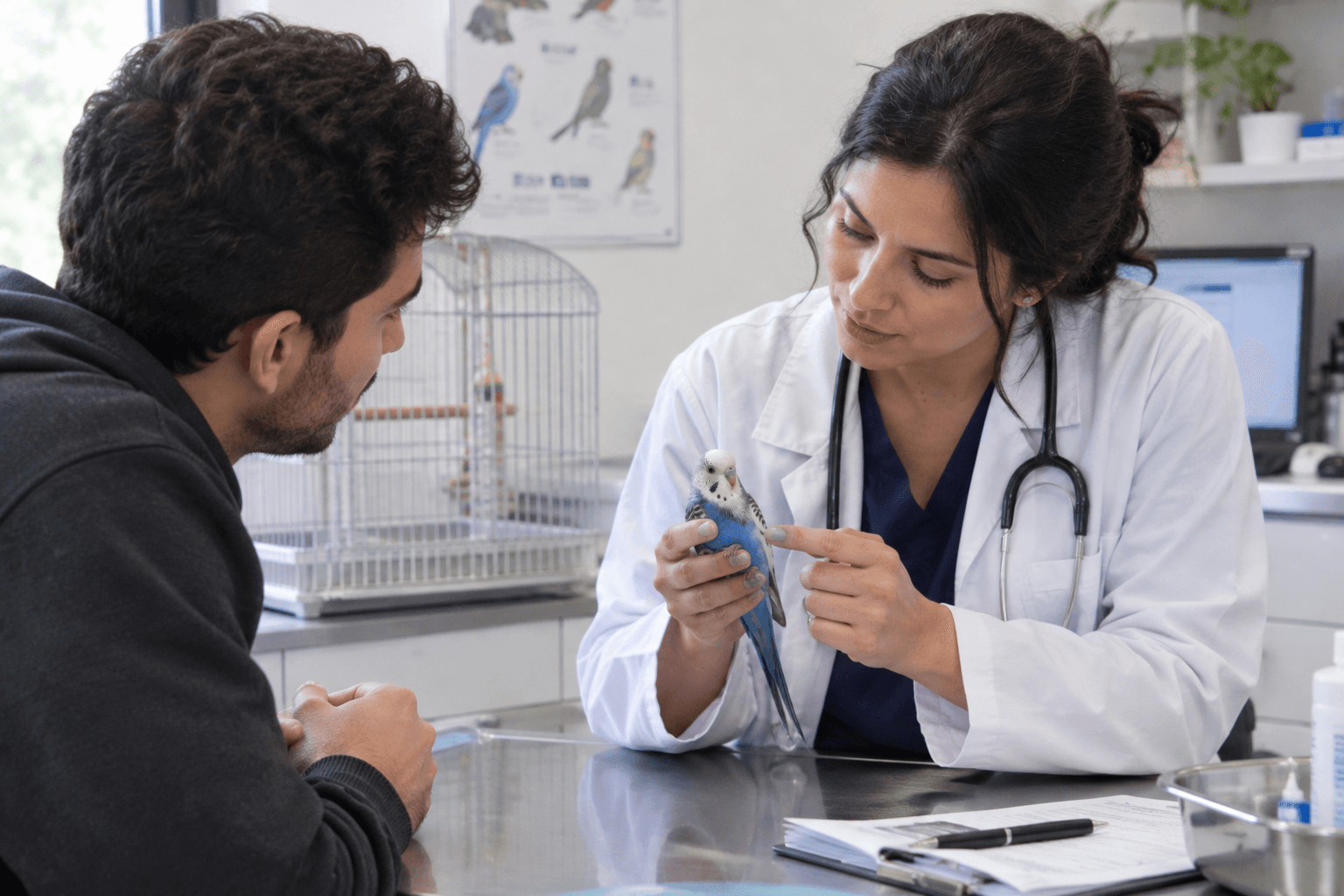
Section Three: Feeding Your Bird and Its Environment — The Foundation of All Health 🌿
If we had to choose the single most important factor that determines your bird’s long-term health — it isn’t medication, it isn’t vitamins, and it isn’t even regular checkups.
It is simply this: what your bird eats every day, and the environment it lives in.
The right diet and the right environment are your bird’s first line of defense before any treatment becomes necessary — because for pet birds, prevention literally means years added to your bird’s life.
🍎 What Does Your Bird Actually Eat?
The most common problem that specialized bird veterinarians encounter daily is this: bird owners feeding their pets seeds alone.
Seeds by themselves are not a complete diet — it’s like a human eating only white rice every single day. It fills the stomach, but it starves the body of essential nutrients it simply cannot do without.
A Balanced Diet for Your Pet Bird Consists of:
🔹 Seeds and Grains (30–40% only):
Not 100% as many owners do. Seeds are high in fat and cause obesity and liver disease when given in excess.
🔹 Pellets and Formulated Foods (40–50%):
These are the ideal nutritional foundation for pet birds because they are scientifically balanced and contain every necessary nutrient. A bird raised exclusively on seeds may initially refuse pellets — but a gradual transition is absolutely achievable with patience.
🔹 Fresh Vegetables and Fruits (20–30%):
This is what makes a dramatic difference in feather quality and immune system strength.
Bird-Friendly Vegetables:
- Broccoli 🥦
- Grated carrots 🥕
- Sweet bell peppers (especially red and orange)
- Dark leafy greens like spinach and kale
Suitable Fruits:
- Apple (seeds removed) 🍎
- Berries of all kinds 🫐
- Pomegranate seeds 🍒
- Papaya and mango
For a deeper dive into the best choices for birds nutrition and what suits each specific species, there’s a dedicated guide well worth reading.
☠️ Toxic Foods You May Not Know About
This section could save your bird’s life — because some foods we consider perfectly healthy and natural are genuine poisons to birds.
🚫 Strictly Forbidden:
| Food | Why It’s Dangerous |
|---|---|
| Avocado 🥑 | Contains “persin” — causes acute heart failure |
| Chocolate 🍫 | Causes seizures and kidney failure |
| Garlic and Onion 🧄 | Destroys red blood cells |
| Apple and Cherry Seeds | Contain cyanide compounds |
| Caffeine (coffee/tea) ☕ | Causes dangerous heart palpitations |
| Excess Salt 🧂 | Leads to kidney failure |
| Unripe Mango | Causes severe digestive upset |
| Mushrooms 🍄 | Toxic even the “safe” varieties for humans |
⚠️ Watch Out for Household Toxins Too:
Birds have an extremely sensitive respiratory system — more so than any other pet. Substances that have zero effect on you can kill your bird within minutes:
- Fumes from overheated non-stick cookware (Teflon/PTFE) — this is the single greatest household danger to pet birds
- Cigarette and tobacco smoke
- Aerosol household sprays (air fresheners, insecticides)
- Fumes from strong chemical cleaning products
- Scented candles burning for extended periods
💡 Golden Rule: If a smell is strong enough for you to feel it in your throat — your bird is experiencing it at ten times the intensity. Move your bird away from it immediately.
🏠 The Ideal Cage and a Healthy Living Environment
Your bird’s cage isn’t just a comfortable enclosure — it is its entire world. Its quality directly determines your bird’s mood, health, and lifespan.
What Makes an Ideal Cage:
📐 Size:
The fundamental rule: your bird must be able to fully spread both wings inside the cage without touching the bars. Larger parrots need cages far bigger than most owners assume — and bigger is always better.
🔲 Bar Design:
- Horizontal bars are preferable as they allow your bird to climb and exercise naturally
- Bar spacing must suit your bird’s size — too narrow can trap the beak, and too wide can trap the head dangerously
🪵 Perches:
- Variety in perch diameter is essential for healthy feet and leg muscles
- Natural wooden perches from untreated trees are far superior to plastic ones
- Wash perches weekly to prevent bacterial buildup
🌡️ Temperature:
- Between 18–26°C (65–79°F) is ideal for most pet birds
- Avoid placing the cage in direct airflow from an air conditioner or open window
- Never place the cage in the kitchen — cooking fumes and fluctuating heat are genuinely dangerous
💡 Lighting:
Birds need a natural light cycle — 10–12 hours of light and 12–14 hours of darkness. Continuous artificial lighting causes hormonal and behavioral disorders over time.
The Ideal Cleaning Routine:
| Task | Frequency |
|---|---|
| Change water | Daily |
| Clean food dishes | Daily |
| Clean cage floor liner | Every 2 days |
| Full cage wash | Weekly |
| Deep disinfection with bird-safe products | Monthly |
🧠 Taming, Bonding, and Mental Health
Here lies a truth that far too many bird owners overlook: pet birds can suffer from depression.
Yes — your bird can experience severe boredom, anxiety, and loneliness. And over time, these psychological states transform into very real physical diseases: feather destruction, refusal to eat, aggression, or incessant screaming.
Signs of a Psychologically Happy Bird:
- ✅ Sings or vocalizes for most of the day
- ✅ Responds actively when you approach
- ✅ Engages enthusiastically with its toys
- ✅ Feathers are clean, smooth, and well-preened
- ✅ Eats with appetite and moves with energy
Signs of a Psychologically Unhappy Bird:
- ❌ Repeatedly plucks its own feathers
- ❌ Screams excessively and relentlessly
- ❌ Refuses interaction even with its closest person
- ❌ Rocks its body repetitively (stereotypy behavior)
- ❌ Sits alone in one corner of the cage for most of the day
How to Improve Your Bird’s Mental Well-Being:
🎯 Environmental Enrichment:
- Introduce new toys every week — birds genuinely get bored with the same toys
- Hang foraging toys that make your bird search for food, mimicking natural wild behavior
- Rearrange perches and toys inside the cage periodically to keep things interesting
🤝 Daily Interaction:
- Even just 15–30 minutes of direct, focused interaction daily makes an enormous difference
- Learn to read your bird’s body language so you know when it wants to play and when it needs rest
For owners who want to start the journey of taming birds the right way — built on a scientific foundation — there’s a dedicated guide that explains how to build your bird’s trust in you, step by careful step.
🌟 Prevention Is Worth a Thousand Cures
Everything we’ve covered in this section serves one single goal: to make you proactive rather than reactive.
A bird that eats well, lives in a clean and appropriate environment, and enjoys daily interaction with its owner — that bird builds an immune system strong enough to fight off disease before it takes hold.
But even under the best possible conditions, your bird may need a real specialist at some point. And this is exactly where SCOTY comes in — giving you instant access to the best bird veterinarians whenever you need them.
In the final and most important section, we’ll answer the question every bird owner eventually asks: how do you find a truly trustworthy bird veterinarian — and what difference does remote veterinary consultation make in your bird’s life?
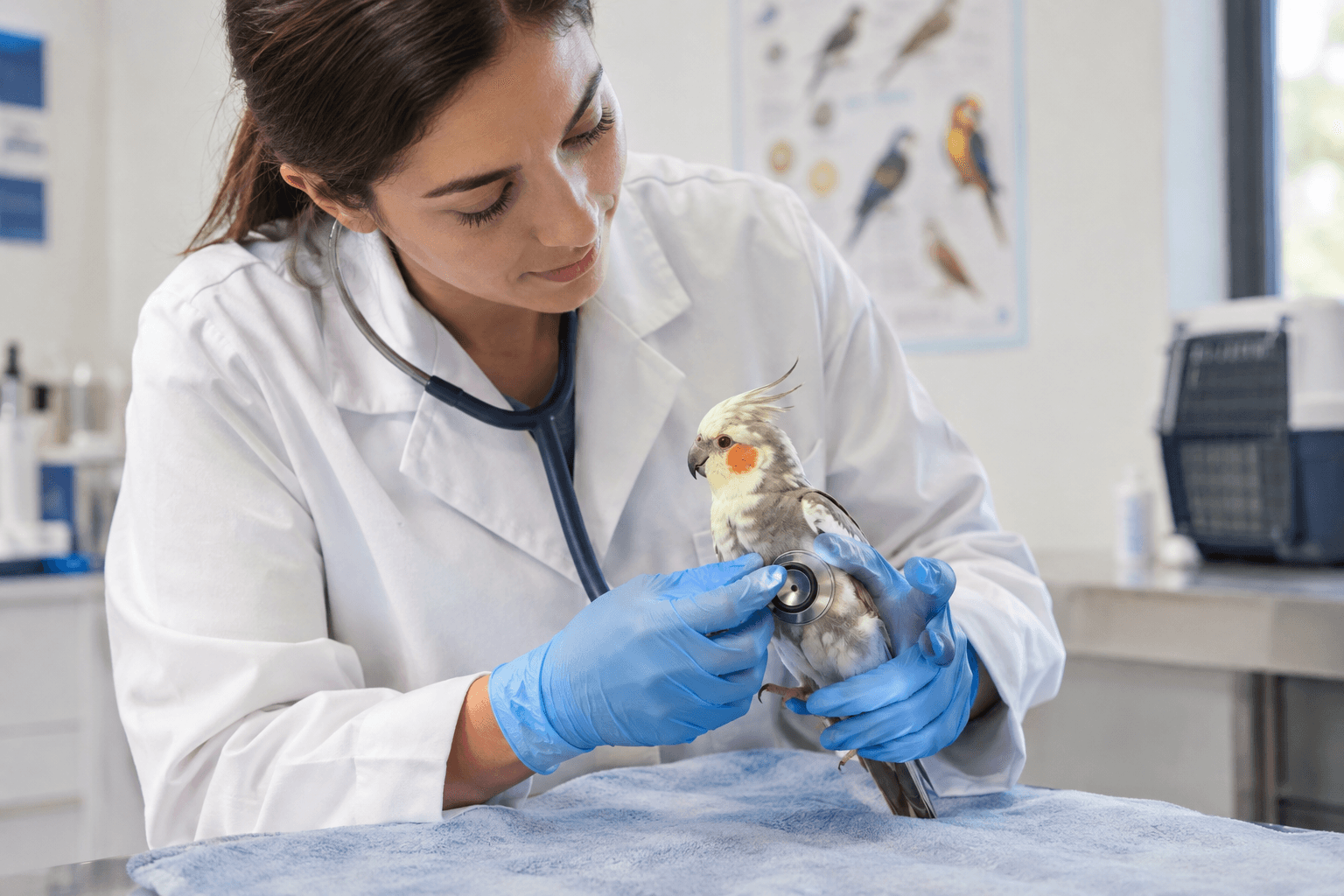
Section Four: How to Find a Trustworthy Bird Veterinarian 🔍
We’ve arrived at the question that concerns every bird owner at some point — whether your bird is in perfect health right now, or you’re in the middle of a moment of real worry.
How do I find a veterinarian who actually understands birds?
This question isn’t as simple as it sounds — because avian medicine is one of the narrowest and least widespread veterinary specializations in the world. But the good news is that the solutions are closer to you than you might imagine.
🎓 What Makes a Qualified Bird Veterinarian?
Not everyone who opens a veterinary clinic can accurately diagnose your bird — and that’s not a criticism, it’s a scientific reality.
Avian medicine is a precise specialization that requires years of additional study and hands-on practice beyond a general veterinary degree.
What to Look For in a Specialized Bird Veterinarian:
✅ Academic Specialization:
- Holds a specialized qualification in avian medicine or exotic animal medicine
- Has documented experience specifically with your type of bird — parrots require very different expertise than canaries or pigeons
✅ Practical Experience:
- Has treated multiple species of pet birds successfully
- Is familiar with the latest medications and treatment protocols specific to birds
- Knows how to handle your bird calmly during examination without causing harmful stress
✅ Communication Style:
- Explains the diagnosis in language you can understand
- Answers your questions patiently without rushing
- Provides a clear treatment plan with a defined follow-up timeline
✅ Medical Documentation:
- Maintains a proper medical record for your bird including its complete health history
- Issues a detailed, clear prescription with every diagnosis
One Important Question to Always Ask Before Booking:
“Do you have experience treating [your bird’s species]? How many similar cases have you handled?”
A confident and qualified vet will answer this clearly and directly. A vet who deflects or avoids the question — that’s all the information you need.
💻 Remote Veterinary Consultation: A Revolution in Bird Care
Just a few years ago, a bird owner living far from a specialized clinic faced a genuinely difficult situation — either travel long distances with a sick bird, or wait and hope things improved on their own.
Today, everything has changed.
Remote veterinary consultation has proven itself to be not a lesser alternative — but in many cases, the faster and more accurate option, for several compelling reasons:
🔹 Your Bird in Its Natural Environment:
When you bring your bird to an unfamiliar clinic, stress alone can temporarily alter its behavior and mask its symptoms, making accurate diagnosis harder. Through a remote consultation, the vet observes your bird in its real environment and sees its true, natural behavior.
🔹 Video Shows What Words Cannot:
Describing symptoms in words has real limitations — but a short video clip showing how your bird breathes, walks, or eats gives the veterinarian invaluable information that no verbal description can fully capture.
🔹 Speed for Non-Emergency Concerns:
Rather than waiting days on an appointment waitlist, you can often receive a consultation the same day.
❓ Questions You Should Always Ask Your Vet
Whether your consultation is remote or in-person, these questions will help you get the maximum benefit from every single session:
Before the Session — Prepare These Details:
- Your bird’s exact age and species
- Precisely when you first noticed the symptoms
- What your bird eats and how frequently
- Whether there’s been any recent change in its environment, diet, or daily routine
- Whether it lives with other birds in the same space
During the Session — Don’t Hesitate to Ask:
- What is the most likely diagnosis, and how certain are you?
- Are any additional laboratory tests needed?
- What are the medications, and what are the exact dosages?
- What signs of improvement should I be looking for?
- When should I follow up with you again?
For more guidance on how to make the most of your veterinary consultations and what topics are worth raising, the vet questions and answers resource brings together the most frequently asked questions with precise, medically sound answers.
🌟 SCOTY: Your Complete Veterinary Clinic in Your Pocket
Let’s be completely honest with you — finding the nearest vet who truly specializes in birds is not easy in many areas. And even when you find one, their next available appointment might be days away, their clinic might be far from home, or you might have no way of knowing their actual expertise level beforehand.
This is precisely the problem that SCOTY was built to solve — a fully integrated remote veterinary clinic that puts everything you need in one place, available whenever you need it.
How Your SCOTY Experience Works, Step by Step:
Step One — Choose Your Vet With Confidence:
Browse complete, detailed professional profiles of specialized veterinarians, read about their qualifications and areas of expertise — including their specific experience with birds. Choose the doctor you feel genuinely confident in, and book your appointment directly from their calendar at a time that suits you perfectly.
Step Two — Document Your Bird’s Condition Before the Session:
Attach photos and precise video clips showing the symptoms that concern you — whether related to feathers, breathing, droppings, or behavior. Your vet reviews these before the session begins, arriving fully prepared with specific, targeted questions rather than generic ones.
Step Three — A Full 30-Minute Session With Your Vet:
Thirty complete minutes of in-depth discussion — covering your bird’s medical history, current symptoms, lifestyle, and every concern on your mind. Enough time for every question and every answer, without feeling rushed.
Step Four — A Certified Electronic Prescription:
If your bird needs treatment, you receive a certified electronic prescription immediately — downloadable and ready to be filled online or at any veterinary pharmacy with complete ease.
Step Five — A Complete Medical File in Your App:
Every report, every diagnosis, and every prescription is automatically saved in your bird’s dedicated medical profile inside the app. You never forget anything, and you never have to start from scratch with a new vet again.
Step Six — And the Most Important Feature of All:
After your session ends, you are never left on your own. You receive a full week of free follow-up through the chat — available around the clock. Any question that comes up, any concern that develops, any change in your bird’s condition — your vet is right there with you. And if further evaluation is needed, a complimentary follow-up call is waiting for you.
This isn’t just a consultation — it’s a complete care system that ensures your bird never faces a difficult moment without real, professional medical support beside it. You can book an appointment right now and give your bird the level of care it truly deserves.
📋 The Responsible Bird Owner’s Roadmap
Before we close, here is a practical summary you can save as your everyday reference:
Your Weekly Bird Care Routine:
- ✅ Weigh your bird weekly — a loss of 10% of body weight warrants an immediate consultation
- ✅ Inspect its feathers, beak, and nails regularly for any abnormalities
- ✅ Track how much food and water it consumes daily
- ✅ Check the bottom of the cage — droppings never lie
Recommended Preventive Checkup Schedule:
- Fully healthy bird: preventive exam every 6–12 months
- Older bird or one with a medical history: every 3–6 months
- Newly acquired birds: examination immediately upon arrival, before any contact with your existing birds
When to Contact a Bird Veterinarian Immediately:
- 🔴 Any difficulty breathing
- 🔴 Loss of balance or seizures
- 🔴 Complete refusal to eat or drink for more than 24 hours
- 🔴 Bleeding from anywhere on the body
- 🔴 Bloody or very dark green droppings
For pet owners who want to contact a veterinary specialist quickly without spending time searching, remember that a specialized animal vet phone number is just a click away, saving you the hassle of a lengthy search.
-
💚 Closing: Your Bird Deserves the Very Best
Your little bird — with all its colors, its songs, and its completely unique personality — has given you something genuinely rare: it sings to you every morning, lights up when you come near, and makes your home feel more alive and warm than it ever could without it.
In return, it needs only one thing from you: awareness and readiness.
Awareness of the signs of illness before they escalate. Readiness with a specialized bird veterinarian you trust — before you ever urgently need one.
Everything you’ve read in this guide — from understanding your bird’s body, to recognizing its most common diseases, to nourishing it well and creating the right environment, to finding the right veterinarian — is just the first step.
The second step is in your hands right now.
Whether your bird is in perfect health and you want a preventive checkup, or you’ve noticed something that’s been worrying you and don’t know where to turn — you can book an appointment with a specialist today, and let your bird receive the care it truly deserves.
Because your little companion doesn’t know how to ask for help — but you know exactly how to give it. 🐦💚